
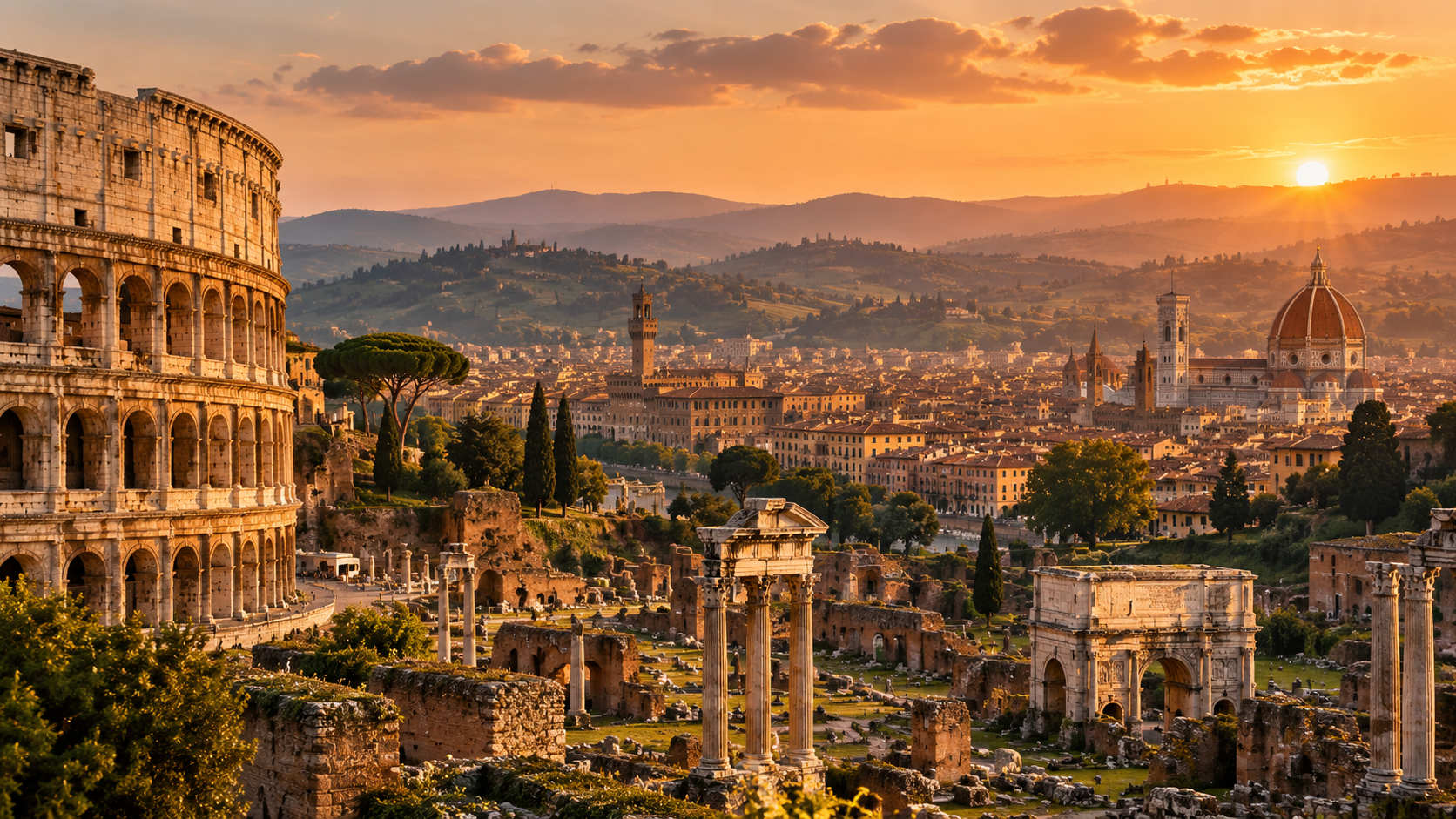
Ask someone what they know about Italian history and ancient Rome usually arrives first.
Fair enough.
Rome built one of history’s most influential empires. Roman law, roads, architecture, language, government, and military organization left marks across Europe and far beyond it.
But Italy existed as a complicated human landscape long before Roman emperors entered the picture.
And after Rome fell?
The story kept moving for another fifteen centuries.
Italy passed through periods of Byzantine, Lombard, Norman, Arab, French, Spanish, Austrian, and papal influence. Independent city-states grew rich through trade. The Renaissance reshaped European art and intellectual life. Nationalists eventually created a unified Italian state in the 19th century. Then came fascism, two world wars, the end of the monarchy, economic transformation, and the modern republic.
So, what is the history of Italy?
The short answer is that Italy is less a straight historical line and more a stack of civilizations built on top of one another.
Before Rome, Italy Was Already Crowded With Cultures
The Italian Peninsula was home to many peoples long before Rome became powerful.
The Etruscans dominated important parts of central Italy. Greek settlers established colonies in southern Italy and Sicily. Samnites, Latins, Umbrians, Sabines, and other groups controlled their own territories.
The peninsula was not one nation.
Not even close.
Mountain ranges divided communities. Coastlines encouraged maritime trade. Fertile valleys attracted settlements, while the central Mediterranean location connected Italy with Greece, North Africa, Iberia, and the eastern Mediterranean.
| Period | Approximate Dates | Why It Matters |
|---|---|---|
| Pre-Roman Italy | Before the 8th century BCE onward | Etruscans, Greeks, Latins and other cultures shaped the peninsula |
| Roman Republic | 509-27 BCE | Rome expanded across Italy and the Mediterranean |
| Roman Empire | 27 BCE-476 CE in the West | Rome became the center of a huge imperial system |
| Medieval Italy | 5th-15th centuries | Kingdoms, communes, papal territories, and city-states developed |
| Renaissance | 14th-16th centuries | Italian cities became centers of art, scholarship, and commerce |
| Unification | 19th century | Separate states were brought into the Kingdom of Italy |
| Italian Republic | 1946-present | The monarchy ended and Italy became a democratic republic |
The Etruscans Were a Major Power Before Rome
The Etruscans developed a sophisticated civilization in central Italy, particularly in areas corresponding roughly to modern Tuscany, northern Lazio, and parts of Umbria.
They built cities, traded across the Mediterranean, created elaborate tombs, worked metal, and developed distinctive religious practices.
Some early Roman institutions were influenced by Etruscan culture.
Even traditional accounts of early Rome include Etruscan kings.
Archaeological sites such as Tarquinia and Cerveteri preserve elaborate tombs decorated with scenes of banquets, music, athletics, and everyday life.
It is a useful correction to the idea that civilization suddenly appeared when Rome became important.
Rome inherited plenty.
Greek Colonies Changed Southern Italy
Beginning around the 8th century BCE, Greek settlers founded communities across southern Italy and Sicily.
The region became so strongly associated with Greek settlement that Romans later called parts of it Magna Graecia, or “Greater Greece.”
Cities such as Syracuse, Taranto, and Naples developed within this wider Greek world.
Greek language, architecture, religion, philosophy, and trade influenced the peninsula deeply.
Even the name Naples comes from Greek roots meaning “new city.”
Italy was multicultural long before anyone used that word.
Rome Started Small
Traditional Roman chronology places the founding of Rome in 753 BCE.
Legends connected the city with Romulus and Remus, twin brothers supposedly raised by a she-wolf.
Great story.
History is less tidy.
Archaeological evidence suggests settlements around the hills beside the Tiber River gradually grew and merged.
Rome’s location helped.
The city sat near a river crossing and trade routes, while remaining inland enough to avoid some immediate coastal threats.
Over time, the settlement expanded politically and militarily.
The Roman Republic Created a New Political System
According to Roman tradition, the monarchy ended in 509 BCE.
Rome became a republic.
Political power was divided among magistrates, assemblies, and the Senate.
Two consuls normally served as the highest elected officials for limited terms.
This system was not democratic in the modern American sense.
Social class mattered enormously.
Wealthy families dominated much of political life, and enslaved people had no political rights.
Women were excluded from formal voting and office.
Still, Roman ideas about citizenship, law, republican institutions, and checks on individual power influenced political thinkers centuries later.
Rome Conquered Italy Before It Conquered the Mediterranean
Roman power did not jump straight from one city to global empire.
Rome first spent centuries fighting neighboring peoples across the Italian Peninsula.
Wars against Latin communities, Samnites, Etruscans, and Greek cities gradually brought most of Italy under Roman control.
The Romans were particularly effective at incorporating conquered communities.
Different regions received different legal relationships with Rome.
Roads connected settlements.
Colonies secured strategic territory.
Military service tied communities into the Roman system.
Rome could lose battles and still return with another army.
That persistence became one of its defining strengths.
The Punic Wars Turned Rome Into a Mediterranean Power
Rome’s greatest early rival was Carthage, a wealthy North African maritime power.
The two states fought three Punic Wars between 264 and 146 BCE.
The most famous involved Hannibal.
He crossed the Alps with an army that famously included elephants and inflicted devastating defeats on Rome.
At Cannae in 216 BCE, Roman forces suffered one of their worst military disasters.
And yet Rome did not surrender.
Eventually the Romans carried the war into North Africa and defeated Hannibal.
By the end of the Punic Wars, Carthage had been destroyed and Rome had become the dominant power of the western Mediterranean.
Expansion Made the Republic Rich – and Unstable
Conquest brought wealth, land, enslaved laborers, and political power into Rome.
It also increased inequality and competition.
Elite families fought over influence.
Military commanders built personal loyalty among soldiers.
Political violence became increasingly normal.
Reformers such as the Gracchi brothers tried to address land and social problems and were killed.
Later, commanders such as Marius and Sulla turned military forces against fellow Romans.
The republic was cracking.
Julius Caesar Did Not Become Rome’s First Emperor
This gets confused all the time.
Julius Caesar became dictator, but technically he was not the first Roman emperor.
Caesar conquered Gaul, gained enormous military prestige, and entered into political conflict with rivals including Pompey.
In 49 BCE, he crossed the Rubicon River with his army, triggering civil war.
After victory, Caesar accumulated extraordinary authority.
A group of senators assassinated him in 44 BCE.
Their goal was partly to protect the republic.
Instead, more civil war followed.
Augustus Became the First Roman Emperor
Caesar’s adopted heir Octavian eventually defeated his major rivals.
In 27 BCE, the Senate granted him the title Augustus.
Historians generally treat this as the beginning of the Roman Empire.
Augustus was clever about power.
He did not simply declare himself king and call it a day.
He preserved many republican institutions while controlling the political and military system behind them.
Under Augustus, Rome entered a long period of imperial stability and expansion.
The Roman Empire Turned Italy Into the Center of a Huge System
At its height, the empire stretched across much of Europe, North Africa, and the Middle East.
Rome became one of the world’s greatest ancient cities.
Aqueducts brought water.
Roads connected distant regions.
Public baths, amphitheaters, temples, markets, and apartment buildings filled urban neighborhoods.
Italy benefited enormously from being the political center of the empire.
Pompeii, preserved by the eruption of Mount Vesuvius in 79 CE, gives modern visitors one of the clearest pictures of Roman urban life.
Pompeii Froze an Ordinary Roman City in Time
When Vesuvius erupted, volcanic material buried Pompeii and nearby communities.
The disaster killed residents but preserved streets, homes, shops, graffiti, mosaics, temples, and everyday objects.
That is what makes Pompeii so powerful.
You are not only looking at imperial monuments.
You see bakeries.
Advertisements.
Garden walls.
Political messages.
Dining rooms.
Some ancient graffiti would not look out of place on a modern bathroom wall.
People were people.
Christianity Changed the Roman World
Christianity began as a small religious movement in the Roman eastern Mediterranean.
It eventually spread throughout the empire, including Rome itself.
Early Christians sometimes faced persecution, although the intensity varied across different periods and regions.
In the 4th century, Emperor Constantine supported Christianity and granted greater religious tolerance.
Later emperors gave Christianity an increasingly central place in imperial life.
Rome became especially important to western Christianity because of its association with the apostles Peter and Paul.
The bishop of Rome eventually developed the authority associated with the papacy.
The Western Roman Empire Fell, but Italy Did Not Disappear
In 476 CE, the last western Roman emperor was removed from power.
That date is traditionally used to mark the end of the Western Roman Empire.
But nobody woke up the next morning and announced the Middle Ages.
Political control simply became more fragmented.
Germanic rulers governed parts of Italy.
The Eastern Roman, or Byzantine, Empire reconquered large territories under Emperor Justinian in the 6th century.
Then the Lombards invaded.
Italy became divided among different powers.
Medieval Italy Was a Political Puzzle
For much of the Middle Ages, there was no unified Italian country.
The peninsula contained kingdoms, duchies, communes, papal territories, and independent cities.
The Pope controlled substantial areas in central Italy known as the Papal States.
The south passed through Byzantine, Lombard, Arab, Norman, and later dynastic control.
Northern and central cities increasingly developed their own political institutions.
Italy was geographically recognizable.
Politically, it was a jigsaw puzzle.
Venice Became a Maritime Superpower
Venice grew from communities around the Venetian Lagoon into one of medieval Europe’s greatest trading powers.
Its merchants built networks across the Adriatic and eastern Mediterranean.
Venetian ships moved spices, textiles, luxury goods, and people between markets.
The republic controlled territories beyond the city itself and became deeply involved in Mediterranean politics.
The architecture visitors admire today reflects that wealth.
St. Mark’s Basilica, the Doge’s Palace, and grand canal-side residences were not created by a sleepy little tourist town.
Venice had money.
Lots of it.
Florence Built Its Power Through Banking and Trade
Florence followed a different path.
Textile production, commerce, and banking helped make the city wealthy.
Powerful families emerged, most famously the Medici.
The Medici were bankers, political operators, patrons of art, and eventually rulers with influence far beyond Tuscany.
Their patronage supported artists, architects, and scholars whose names now define the Renaissance.
The Renaissance Changed European Culture
The Renaissance began gradually rather than on one exact morning in Florence.
From roughly the 14th through 16th centuries, Italian cities became major centers of art, scholarship, architecture, literature, and scientific inquiry.
Think about the names involved.
- Leonardo da Vinci worked across painting, engineering, anatomy, and design.
- Michelangelo created sculpture, painting, and architecture on a monumental scale.
- Raphael became one of the defining painters of the High Renaissance.
- Donatello transformed sculpture.
- Brunelleschi reshaped architecture, including Florence Cathedral’s famous dome.
- Machiavelli wrote about political power with an uncomfortable level of clarity.
The Renaissance did not simply mean “people rediscovered old statues.”
It involved renewed engagement with classical Greek and Roman texts, new artistic techniques, expanding literacy among elites, urban competition, patronage, and intellectual exchange.
Why Did the Renaissance Happen in Italy?
There is no single reason.
Italian cities had accumulated wealth through banking and Mediterranean trade.
Political competition encouraged rulers to spend money on buildings, monuments, churches, and art.
Ancient Roman ruins were physically present across the peninsula.
Scholars had access to classical texts.
Urban elites used culture to demonstrate status.
And because Italy remained politically divided, cities competed with one another constantly.
Florence wanted to impress people.
So did Venice.
So did Milan.
So did Rome.
Competition can be exhausting.
It can also produce spectacular architecture.
Rome Became a Renaissance Center Too
Florence gets much of the early Renaissance attention, but Rome became crucial during the High Renaissance.
Popes commissioned enormous artistic and architectural projects.
Michelangelo painted the ceiling of the Sistine Chapel.
Raphael worked in the Vatican.
St. Peter’s Basilica took shape through the work of multiple architects and artists over generations.
The Catholic Church became one of Europe’s greatest artistic patrons.
Italy Became a Battlefield for European Powers
Italy’s wealth attracted attention.
That was not always good news.
Beginning in the late 15th century, major European powers fought for influence on the peninsula.
France, Spain, the Holy Roman Empire, and local Italian states became involved in repeated conflicts known collectively as the Italian Wars.
Over time, Spanish influence became particularly strong across large parts of Italy.
Political independence weakened in several regions.
The South Developed Differently From the North
One reason Italian regional differences remain so visible today is that the peninsula followed different political and economic paths for centuries.
Naples and Sicily were governed under various dynasties and kingdoms.
Northern cities had different commercial structures.
The Papal States divided central Italy.
Venice maintained its own republic.
Tuscany followed another path.
This long fragmentation created strong local identities.
It also explains why Italian dialects, food traditions, architecture, and historical memories can change dramatically over relatively short distances.
Napoleon Shook Up the Italian Peninsula
French revolutionary and Napoleonic armies entered Italy during the late 18th and early 19th centuries.
Old political structures were reorganized.
New states appeared.
Legal and administrative reforms spread.
Napoleon’s eventual defeat restored older rulers in many areas, but Europe could not simply reset everything.
Ideas about citizenship, nationalism, constitutional government, and national unity had spread.
Italian nationalism became stronger.
The Risorgimento Was the Movement Toward Italian Unity
The 19th-century movement toward unification is known as the Risorgimento.
It involved revolutionaries, intellectuals, monarchists, soldiers, diplomats, and ordinary people who did not always agree on what a united Italy should look like.
Three names appear constantly.
Giuseppe Mazzini promoted nationalism and republican ideas.
Count Camillo di Cavour, prime minister of Piedmont-Sardinia, relied heavily on diplomacy and statecraft.
Giuseppe Garibaldi became the romantic military hero of unification.
Different methods.
Same general direction.
Garibaldi’s Red Shirts Became Legendary
In 1860, Garibaldi led a volunteer force known as the Thousand into Sicily.
His campaign helped overthrow Bourbon rule in the Kingdom of the Two Sicilies.
Garibaldi then transferred conquered territory to King Victor Emmanuel II.
In 1861, the Kingdom of Italy was proclaimed.
But unification was not completely finished.
Italy Was Unified in Stages
- The Kingdom of Italy was proclaimed in 1861.
- Venetia became part of Italy in 1866.
- Italian forces entered Rome in 1870.
- Rome became the capital in 1871.
- Some Italian-speaking or contested territories joined the state only after World War I.
So when people say “Italy was unified in 1861,” that is correct but simplified.
The map continued changing.
Making Italy Was Easier Than Making Italians
A famous phrase associated with the unification era suggested that Italy had been created and Italians now had to be created.
The idea makes sense.
People identified strongly with villages, cities, regions, and local dialects.
Standard Italian was not the everyday spoken language for everyone.
Economic differences between regions were significant.
The new state had to build national institutions, schools, military systems, transportation networks, and a shared political identity.
Unity on a map did not erase centuries of regional history.
Large Numbers of Italians Left the Country
From the late 19th century into the early 20th century, millions of Italians emigrated.
The United States became one of the major destinations.
Italian communities grew in New York, Boston, Philadelphia, Chicago, New Orleans, San Francisco, and many other American cities.
Others migrated to Argentina, Brazil, Canada, Australia, and elsewhere.
Poverty, limited land, unemployment, and hopes for better opportunities pushed many families to leave.
This is why Italian history is also part of American history.
Italian-American Culture Developed Its Own Identity
Italian immigrants carried regional traditions with them.
Many came from southern Italy and Sicily.
Food adapted to American ingredients and economic conditions.
Neighborhood traditions evolved.
Italian-American cuisine eventually became its own cultural category.
Some dishes Americans strongly associate with “Italian food” developed differently in Italy or are far less common there.
History does strange things to recipes.
World War I Put Enormous Pressure on Italy
Italy entered World War I in 1915 on the Allied side.
Much of the fighting occurred against Austria-Hungary along mountainous northeastern fronts.
Conditions were brutal.
Battles along the Isonzo River and in the Alps caused enormous casualties.
Italy ended the war among the victorious powers and gained additional territory.
But victory did not produce political calm.
Economic hardship, social conflict, nationalist resentment, strikes, and political violence followed.
Mussolini and Fascism Rose After World War I
Benito Mussolini built the Fascist movement during the political turmoil after the war.
In 1922, the March on Rome helped pressure King Victor Emmanuel III into appointing Mussolini prime minister.
Over the following years, democratic institutions were dismantled.
Opponents were intimidated, imprisoned, exiled, or killed.
Press freedom disappeared.
Fascism became a dictatorship.
Fascist Italy Pursued Empire
Mussolini wanted Italy to be treated as a major imperial power.
The regime invaded Ethiopia in 1935 and expanded colonial ambitions in Africa.
Italy also intervened in the Spanish Civil War on the side of Francisco Franco.
Relations with Nazi Germany became increasingly close.
In 1938, the Fascist government introduced antisemitic racial laws that stripped Italian Jews of rights and excluded them from major areas of public life.
Italy Entered World War II in 1940
Mussolini entered the war alongside Nazi Germany in June 1940.
Military campaigns went badly in several regions.
By 1943, Allied forces had invaded Sicily.
Mussolini was removed from power.
The Italian government signed an armistice with the Allies in September.
Then the situation became even more chaotic.
Germany occupied much of northern and central Italy.
Mussolini headed a German-supported Fascist state in the north.
Italian resistance movements fought against German occupation and Fascist forces.
The country became both a battlefield and a civil conflict zone.
The War Ended the Fascist Regime and Eventually the Monarchy
Mussolini was captured and killed by Italian partisans in April 1945.
The war left Italy devastated.
Cities, railways, factories, homes, and infrastructure had suffered major damage.
Political legitimacy had collapsed.
The monarchy was deeply associated in many people’s minds with the Fascist era and its failures.
In 1946, Italians voted in a referendum between monarchy and republic.
The republic won.
The royal family left the country.
The Italian Republic Was Born in 1946
The referendum marked a fundamental break with the old political order.
Italian women participated nationally in the vote, making this transition particularly important in the history of political rights.
A Constituent Assembly drafted a new constitution.
The Constitution entered into force on January 1, 1948.
Italy became a parliamentary republic with a constitutional system designed partly to prevent a return to authoritarian rule.
Postwar Italy Changed at Incredible Speed
The Italy of 1945 was poor and damaged.
The Italy of the 1960s looked very different.
Rapid industrialization and economic growth transformed the country during the period often called the Italian economic miracle.
Manufacturing expanded.
Car ownership rose.
Consumer goods entered ordinary households.
Millions of Italians moved from rural areas and the south toward industrial cities in northern Italy.
Turin became strongly associated with automobile production.
Milan grew as a center of finance, industry, fashion, and design.
The Fiat 500 Became a Symbol of a Changing Country
The small Fiat 500 is now treated as a cute piece of Italian nostalgia.
In the postwar period, affordable cars represented something much larger.
Mobility increased.
Families traveled differently.
Workers could commute farther.
Domestic tourism expanded.
The car became part of Italy’s economic and social transformation.
Television Helped Spread Standard Italian
Italy entered the modern era with enormous linguistic variation.
Regional languages and dialects remained central to daily life.
National education helped spread standard Italian.
Television accelerated the process.
As families across the country watched the same programs, standard Italian entered homes in ways that earlier state institutions had struggled to achieve.
Media helped unify language decades after the political state had been unified.
The 1960s and 1970s Were Not Just About Fashion and Vespas
Italy’s glamorous international image can obscure a difficult political period.
The country experienced mass demonstrations, labor conflict, political radicalization, terrorism, and violence.
The late 1960s through the early 1980s included the period often called the Years of Lead.
Far-left and far-right extremist groups carried out bombings, kidnappings, and assassinations.
One of the most shocking events was the 1978 kidnapping and murder of former prime minister Aldo Moro by the Red Brigades.
The era left lasting political scars.
Modern Italy Still Carries Its Regional History
Political unification did not make Palermo feel like Milan.
And it never was going to.
Italy’s regional diversity remains one of the country’s defining features.
| Region or City | Historical Layer | What Visitors Notice Today |
|---|---|---|
| Rome | Ancient, papal, national capital | Roman ruins, churches, government buildings |
| Florence | Medieval commune and Renaissance center | Art, palaces, churches, Medici legacy |
| Venice | Maritime republic | Canals, merchant architecture, eastern influences |
| Naples | Greek, Roman, Spanish and Bourbon layers | Dense historic center, churches, palaces, food traditions |
| Sicily | Greek, Roman, Arab, Norman and Spanish influence | Temples, mosaics, architecture, distinctive cuisine |
| Milan | Medieval power, Austrian influence, industrial growth | Gothic architecture, business, fashion, design |
Sicily Might Be Italy’s Best Example of Layered History
Sicily sits near the center of the Mediterranean and almost everyone passing through the region seems to have noticed.
Greek settlers built major temples.
Rome took control.
Arab rulers transformed agriculture, language, and urban culture.
Normans conquered the island and created architecture blending Latin Christian, Byzantine, and Islamic influences.
Later came Spanish and Bourbon rule.
Walk through Palermo and you can see pieces of several worlds within a few streets.
Sicilian food tells the same story.
Citrus, nuts, sweets, spices, pasta traditions, seafood, and street foods carry centuries of cultural exchange.
Italian Food Makes More Sense When You Know the History
There is no single traditional Italian cuisine.
There are regional cuisines.
That distinction matters.
- Northern regions traditionally rely more heavily on butter, rice, polenta, and certain cheeses.
- Central Italy has strong traditions involving pasta, pork, beans, and olive oil.
- Southern cuisine makes extensive use of tomatoes, vegetables, durum wheat pasta, olive oil, and seafood.
- Sicilian cooking reflects centuries of Mediterranean cultural exchange.
- Regional breads, cheeses, wines, cured meats, and pasta shapes can change within relatively short distances.
And tomatoes?
They arrived from the Americas after European contact with the New World.
Ancient Romans were not sitting around eating spaghetti pomodoro.
That would require both spaghetti in its modern form and tomatoes to cooperate with the timeline.
The Catholic Church Has Shaped Italian History for Centuries
Rome became the center of western Catholic Christianity.
The papacy exercised both spiritual and political power for centuries.
Popes ruled the Papal States in central Italy until Italian unification.
Conflict between the Italian state and the papacy continued after Rome was annexed.
In 1929, the Lateran agreements created Vatican City as an independent state within Rome and resolved key disputes between Italy and the Holy See.
This explains one of modern geography’s strangest facts.
You can be in Rome, walk across an invisible international boundary, and suddenly be in another sovereign country.
Italy Became Part of the European Integration Project
After World War II, Italy joined the institutions that eventually developed into today’s European Union.
European integration was partly intended to tie former wartime rivals together economically and politically.
Italy was one of the founding members of the European Economic Community in 1957.
The country later adopted the euro.
That made modern Italian history inseparable from the broader history of postwar Europe.
Why Does Ancient History Still Feel So Visible in Italy?
Because people kept building in the same places.
Rome never disappeared.
Neither did Naples.
Verona, Bologna, Florence, and many other cities grew over older settlements.
That means history often sits literally underneath modern life.
Metro construction in Rome can encounter archaeological remains.
Medieval churches incorporate Roman columns.
A restaurant may occupy a centuries-old building beside an ancient wall.
This is one reason Italy feels different from historical sites where ruins sit far away from modern settlements.
In Italy, the past keeps getting in the way of the present.
Usually in a beautiful way.
FAQ About the History of Italy
When did Italian history begin?
Human settlement in the Italian Peninsula goes back thousands of years. Long before Rome, the region was home to cultures including the Etruscans, Greeks, Latins, Samnites, and many others.
When was ancient Rome founded?
Traditional Roman chronology gives 753 BCE as the founding date of Rome. Archaeology suggests that settlements around the city’s hills developed gradually rather than appearing on one exact day.
When did the Roman Empire fall?
The Western Roman Empire is traditionally said to have ended in 476 CE when the last western emperor was removed. The Eastern Roman Empire continued for nearly another thousand years.
When did Italy become one country?
The Kingdom of Italy was proclaimed in 1861 during the Risorgimento. Venetia joined in 1866, and Rome was incorporated in 1870 before becoming the capital the following year.
Who helped unify Italy?
Major figures included Giuseppe Garibaldi, Count Camillo di Cavour, Giuseppe Mazzini, and King Victor Emmanuel II. Unification resulted from diplomacy, war, popular movements, and political negotiation rather than one person’s actions.
When did Italy become a republic?
Italians voted to replace the monarchy with a republic in the referendum of June 2, 1946. The new Constitution entered into force on January 1, 1948.
What are the best places to visit for Italian history?
Rome, Pompeii, Florence, Venice, Ravenna, Naples, Sicily, Bologna, Verona, and Turin all reveal different periods. Rome alone contains ancient, medieval, Renaissance, papal, Fascist-era, and modern layers.
Italy’s History Is Really a History of Layers
So, what is the history of Italy?
It is tempting to answer with Rome.
That would be convenient.
And very incomplete.
The Italian Peninsula was already culturally crowded before Roman power emerged.
Etruscans built wealthy cities.
Greeks founded colonies in the south.
Rome then expanded from one city into a republic and eventually an empire that changed the Mediterranean world.
When western imperial authority collapsed, Italy did not vanish.
It fragmented.
Byzantines, Lombards, popes, Normans, city governments, dynasties, and foreign powers divided the peninsula between them.
That fragmentation created problems, but it also produced distinct regional cultures.
Venice became a maritime empire.
Florence turned banking wealth into Renaissance art.
Rome became one of the centers of Christian power.
Sicily absorbed Greek, Arab, Norman, Spanish, and Italian influences.
Naples developed inside a different political world from Milan.
For centuries, “Italy” described a geographic and cultural space more clearly than it described one state.
Then nationalism changed the equation.
The 19th-century Risorgimento created a unified kingdom.
But political borders did not instantly erase local languages, economic divisions, or regional identity.
Modern Italy had to build itself.
Schools spread standard Italian.
Railways connected regions.
Military service brought men from different parts of the peninsula together.
Migration carried millions of Italians abroad.
Then the 20th century arrived with war, fascism, dictatorship, occupation, resistance, and devastation.
The monarchy ended.
The republic began.
Postwar economic growth transformed cities and everyday life.
Television changed language.
Cars changed mobility.
Factories drew workers north.
Italy became part of an increasingly integrated Europe.
And through all of this, older history remained physically present.
That may be the most striking thing about Italy.
The country rarely seems to throw the old layer away before adding the next one.
A Roman amphitheater becomes part of a modern city.
A medieval street fills with scooters.
A Renaissance palace contains government offices.
An ancient road runs beneath modern traffic.
A neighborhood restaurant serves recipes shaped by ingredients that arrived through centuries of trade and migration.
History is not sealed behind glass.
It is under your feet.
If you walk through Rome, you can move from a building created under Mussolini to a Baroque church, a Renaissance palace, a medieval tower, and an ancient Roman ruin without needing a car.
In Florence, Renaissance architecture sits inside a living commercial city.
In Venice, the urban structure still reflects the needs of a maritime republic.
In Palermo, churches and palaces reveal cultural mixtures that make simple labels nearly useless.
In Pompeii, ordinary Roman homes remind you that famous historical periods were once just everyday life.
And maybe that is the clearest answer.
Italian history is not one civilization followed neatly by another.
It is accumulation.
Etruscan beneath Roman.
Roman beneath medieval.
Medieval beside Renaissance.
Renaissance beside modern.
Regional identities inside a national identity that is younger than many of the buildings tourists visit.
Once you understand that, Italy stops feeling like a collection of famous monuments.
It starts feeling like one enormous historical conversation that has been going on for thousands of years.
Leave a Reply