
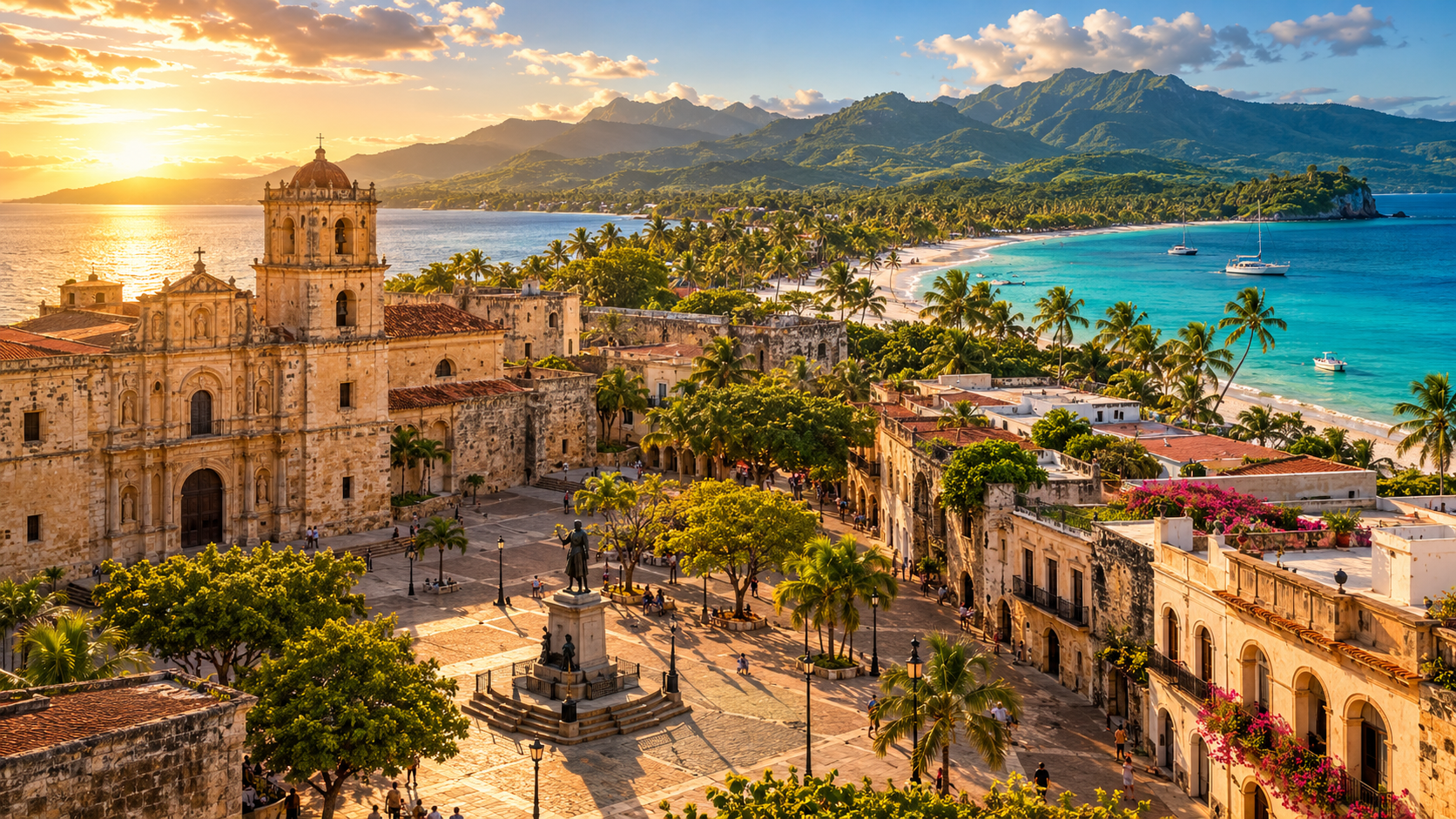
For many Americans, the Dominican Republic means one thing first: beaches.
White sand. Palm trees. Resort pools. Maybe a frozen drink somewhere in the picture.
Fair enough.
The country does have some of the Caribbean’s most famous resort coastlines. But if you leave the hotel zone, the Dominican Republic gets much more interesting very quickly.
You find one of the oldest European colonial cities in the Americas. Underground freshwater lagoons sit inside limestone caves near the capital. The highest mountain in the Caribbean rises in the interior. Waterfalls hide in green valleys. Indigenous Taíno history appears in caves and archaeological collections. Offshore islands look like somebody turned the saturation slider too high.
And then there are the cities themselves.
Santo Domingo feels completely different from Punta Cana. Puerto Plata has Victorian architecture and a mountain rising almost directly behind the city. La Romana gives you access to an unusual stone village above the Chavón River. Samaná feels greener, wetter, and more dramatic.
So if you came looking for Dominican Republic famous landmarks, do not limit the list to monuments.
Some of the country’s best landmarks are entire landscapes.
Which Dominican Republic Landmarks Should First-Time Visitors See?
| Landmark | Location | Best For |
|---|---|---|
| Colonial City of Santo Domingo | Santo Domingo | History and architecture |
| Los Tres Ojos | Santo Domingo | Caves and freshwater lagoons |
| Pico Duarte | Central mountains | Hiking and mountain scenery |
| Isla Saona | Southeast coast | Beaches and boat trips |
| Altos de Chavón | La Romana | Architecture and river views |
| 27 Charcos de Damajagua | Puerto Plata region | Adventure and waterfalls |
| Bahía de las Águilas | Southwest | Remote beaches and nature |
| Samaná Peninsula | Northeast | Waterfalls, coastline, whale season |
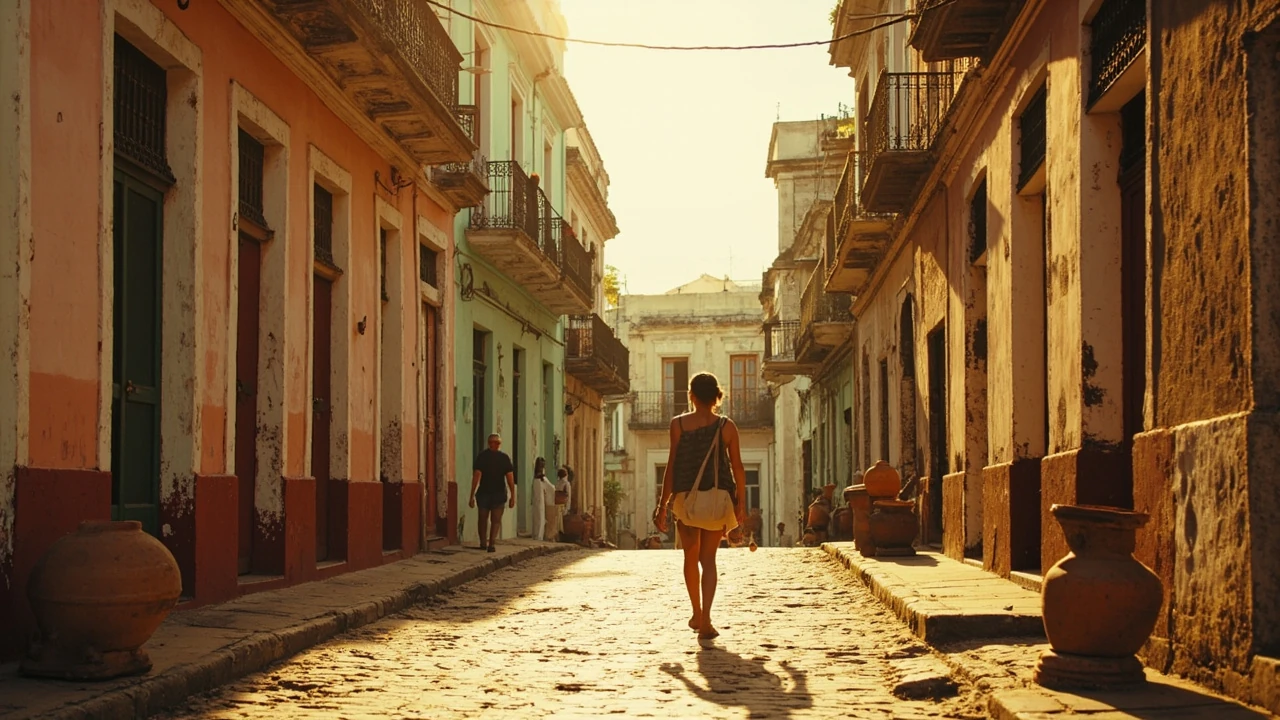
The Colonial City of Santo Domingo Is the Big Historical One
If you want to understand Dominican history, start in Santo Domingo.
The Colonial City, also known as Zona Colonial, sits beside the Ozama River and contains some of the most historically significant European colonial architecture in the Americas.
This is not just an old neighborhood with nice balconies.
It became one of the earliest centers of Spanish colonial administration in the Americas.
The street plan, fortifications, religious buildings, and government structures influenced later colonial cities across the region.
Today, the area is still very much alive.
Cafés occupy old buildings. Locals walk through plazas. Hotels hide behind stone façades. Music drifts from restaurants in the evening.
That mix keeps it from feeling like a giant museum set.
Calle Las Damas Is One of the Streets to Know
Calle Las Damas runs through the historic district and is often described as the oldest paved street in the Americas.
The street passes several major colonial buildings and gives you a good introduction to the neighborhood’s scale.
It is easy to walk.
And unlike many famous historical sites, you do not need to stand behind a barrier imagining what city life looked like.
The street is still part of city life.
Alcázar de Colón Brings the Colonial Period Into Focus
On Plaza de España stands the Alcázar de Colón.
The palace is associated with Diego Colón, son of Christopher Columbus, and his wife María de Toledo.
Its stone rooms and arcades reflect the early Spanish colonial period.
Today it operates as a museum.
The building helps make one thing very clear: Santo Domingo was not a minor settlement on the edge of the Spanish Empire.
It became an important administrative center very early in European colonization of the Americas.
The Cathedral Is Another “First”
The Catedral Primada de América is one of Santo Domingo’s central landmarks.
Construction began during the early colonial period, and the cathedral became the first cathedral in the Americas.
Its exterior feels solid and almost fortress-like in places, while the interior mixes Gothic and later architectural influences.
The cathedral sits near Parque Colón, one of the easiest places to stop, sit down, and watch the neighborhood work around you.
Fortaleza Ozama Still Guards the River
Fortaleza Ozama overlooks the Ozama River from the eastern edge of the historic district.
The fortress formed part of Santo Domingo’s early defensive system.
Its Torre del Homenaje is one of the most recognizable surviving military structures from the colonial city.
Climb into the complex and the reason for the location becomes obvious.
You can see the river and the approaches toward the old port.
Defense was built into the geography.
Los Tres Ojos Feels Completely Different From the City Above
Only a short drive from central Santo Domingo, Los Tres Ojos National Park gives you one of the strangest transitions in the capital.
You leave traffic and city streets.
Then you walk down a staircase into limestone caves filled with intensely colored freshwater.
The name means “The Three Eyes,” referring to three main underground lagoons.
Another open-air lagoon can be reached through the cave system.
The water catches blue and green light in ways that look almost artificial.
It is not.
Why Is the Water So Clear?
The lagoons sit within a limestone cave environment.
Rock formations, groundwater, and filtered light create the unusual visual effect.
It is especially striking after the bright Caribbean sun outside.
One minute you are sweating.
The next you are staring into cool blue water beneath a cave ceiling.
Bring shoes with grip.
Stone steps and humid surfaces can be slippery.
Pico Duarte Is the Caribbean’s Highest Mountain
Beach destinations are not supposed to have cold mountain mornings.
Apparently nobody told the Dominican Republic.
Pico Duarte rises to 3,087 meters, or about 10,125 feet, making it the highest mountain in the Caribbean.
The peak sits in the country’s central mountain system between protected national parks.
Reaching it is not a quick sightseeing stop.
Popular routes generally involve multi-day hiking and official guides.
You move through tropical vegetation, pine forest, mountain terrain, and cooler high-elevation environments.
The temperature difference can surprise travelers who packed only beach clothes.
A swimsuit is not useful on a cold mountain morning.
Jarabacoa Is the Gateway to Mountain Dominican Republic
Jarabacoa sits in the central highlands and is one of the country’s main mountain-adventure bases.
The surrounding landscape includes rivers, waterfalls, pine-covered slopes, and agricultural valleys.
Many Pico Duarte itineraries begin in this general region.
But you do not need to climb the highest peak to enjoy the mountains.
Rafting, hiking, canyoning, and shorter waterfall excursions are common.
After several days on the coast, the cooler air can feel almost shocking.
Isla Saona Looks Like the Caribbean Stereotype – in a Good Way
Saona Island lies off the southeastern coast and forms part of Cotubanamá National Park.
It is one of the most popular day-trip destinations in the country.
There is a reason.
White sand runs beneath tall coconut palms. Shallow water shifts between pale turquoise and deeper blue. Catamarans and speedboats cross from the mainland.
It is not exactly undiscovered.
Expect other visitors.
But the landscape is still impressive.
Most Saona Trips Start Around Bayahíbe
Bayahíbe is one of the main departure points for boats heading toward Saona.
Trips often stop at shallow natural-pool areas along the route before continuing toward beaches on the island.
Mano Juan is the island’s main inhabited settlement.
If you have the option, smaller-group trips usually provide a more relaxed experience than the largest party boats.
And please leave starfish underwater.
They do not need a photo session.
Saona Is Also Important for Sea Turtles
The island is an important nesting area for marine turtles.
That makes Saona more than a pretty beach stop.
Protected habitats, reefs, mangroves, and nesting areas all form part of the larger ecosystem.
Responsible tours matter because heavy tourism and fragile coastal environments are not always natural friends.
Altos de Chavón Looks Ancient, but It Isn’t
Here is where things get interesting.
Altos de Chavón looks like a centuries-old Mediterranean village.
It is not.
The stone complex above the Chavón River was built during the 20th century and opened in the early 1980s.
That does not make it fake in the theme-park sense.
It makes it an architectural project inspired by older Mediterranean design.
Stone lanes, small plazas, galleries, restaurants, and the Church of St. Stanislaus fill the village.
The Amphitheater Made Altos de Chavón Famous
The open-air amphitheater holds thousands of spectators and has hosted international performers since the village opened.
The surrounding river views are even more dramatic than the architecture.
From the edge of the village, the Chavón River cuts through dense green terrain far below.
If you are staying near La Romana or Casa de Campo, it is one of the easiest landmark trips to add.
Puerto Plata’s Teleférico Changes the View
Puerto Plata sits on the north coast beneath Mount Isabel de Torres.
The mountain rises sharply behind the city, making the setting easy to recognize from a distance.
A cable-car system has traditionally carried visitors toward the summit area, where botanical vegetation and panoramic views spread across the coast.
Conditions and operating status can change, so check locally before planning around the ride.
The view is the important part.
From above, the city, Atlantic coastline, and green northern landscape unfold beneath you.
Puerto Plata’s Historic Center Is Worth Walking
Colorful buildings and Victorian-era architecture give central Puerto Plata a different feel from Santo Domingo.
Parque Independencia, often called Central Park locally, sits near some of the city’s best-known streets.
Umbrella-covered pedestrian areas and brightly painted façades have also become popular photo stops.
But do not race through just collecting pictures.
Walk a few blocks farther.
The city feels more interesting when you see everyday shops, homes, and cafés alongside the restored center.
Fort San Felipe Faces the Atlantic
Fortaleza San Felipe stands near Puerto Plata’s waterfront.
The Spanish built the fort during the colonial period to protect the coastal settlement and harbor.
The thick stone walls are modest compared with giant European fortresses.
Still, the location is excellent.
The ocean sits directly beyond the fort, and the surrounding malecón makes the area easy to combine with a walk along the waterfront.
Damajagua Turns Waterfalls Into an Adventure Course
The 27 Charcos de Damajagua, often shortened simply to Damajagua, sits inland from Puerto Plata.
This is not a waterfall where you stand behind a railing for three minutes.
Guided routes move through a series of pools, cascades, natural slides, and rocky channels.
Depending on water conditions and the route offered, visitors may hike, swim, slide, or jump through sections of the canyon.
Helmets and life jackets are part of the experience.
Your dignity may or may not survive the natural slides.
Samaná Is One of the Country’s Most Dramatic Regions
The Samaná Peninsula extends into the Atlantic on the northeast side of the Dominican Republic.
It feels wetter, greener, and more tropical than some resort zones.
Mountains drop toward beaches. Coconut palms cover hillsides. Small coastal roads connect towns and fishing areas.
It is one of the places where the country’s natural landscape becomes the landmark.
Salto El Limón Is the Classic Samaná Waterfall
El Limón waterfall drops through lush vegetation in the Samaná region.
Visitors commonly reach it by hiking, with some tours also traditionally involving horseback routes.
The falls plunge into a natural pool surrounded by tropical greenery.
Go prepared for mud if conditions are wet.
This is not the day for white sneakers you care about deeply.
Humpback Whales Make Samaná Seasonal
Samaná Bay is internationally known for seasonal humpback whale activity.
Whales migrate into the region during winter for breeding and calving.
Boat excursions operate during the season.
As always with wildlife tourism, distance matters.
Choose operators that respect regulations and avoid crowding animals.
The whale does not owe anybody a close-up.
Bahía de las Águilas Feels Far From the Resort Belt
Bahía de las Águilas lies in the far southwest near Jaragua National Park.
The long beach is famous for clear water, pale sand, and very limited development compared with major resort areas.
Getting there requires more effort than reaching Punta Cana.
That is part of the appeal.
The surrounding southwest is drier, more rugged, and less densely developed than the country’s main tourism corridors.
The scenery feels almost like a different nation.
The Southwest Rewards Travelers Who Have More Time
Most short Dominican vacations never reach this corner.
Distances are longer.
Infrastructure is lighter.
But travelers who make the journey find lagoons, desert-like vegetation, protected landscapes, beaches, and small towns far removed from the all-inclusive experience.
This is the version of the country for people who want road-trip energy rather than resort convenience.
Lago Enriquillo Is Below Sea Level
Lake Enriquillo is one of the country’s strangest natural landmarks.
The hypersaline lake lies below sea level in a hot, dry basin in the southwest.
The surrounding landscape feels almost desert-like compared with the palm-covered east.
American crocodiles inhabit the broader lake ecosystem.
So do iguanas and numerous bird species.
This is another reminder that Dominican geography is far more varied than beach advertising suggests.
Basílica de Higüey Is a Modern Religious Landmark
In Higüey, the Basílica Catedral Nuestra Señora de la Altagracia stands out immediately because of its unusual modern architecture.
The basilica is one of the country’s most important Catholic pilgrimage centers.
It is dedicated to Our Lady of Altagracia, who holds deep religious importance in Dominican Catholic tradition.
The building’s enormous concrete arches make it look completely different from the colonial churches in Santo Domingo.
If you are staying in Punta Cana, Higüey is close enough to show you a more everyday Dominican city beyond the resort coast.
Faro a Colón Is Impossible to Miss
The Columbus Lighthouse, or Faro a Colón, is one of Santo Domingo’s most unusual modern monuments.
The giant cross-shaped structure was inaugurated in 1992.
It was built as a memorial connected with Christopher Columbus and the 500th anniversary of his first voyage to the Americas.
The monument is huge.
Whether you find it impressive, strange, severe, or all three at once is another matter.
Its symbolism also sits within a much broader and more difficult history involving colonization and Indigenous peoples.
That context is worth remembering rather than treating the monument as a simple photo stop.
Las Terrenas Mixes Beach Life With a Real Town
Las Terrenas on the Samaná Peninsula has become one of the country’s best-known beach towns outside the big resort zones.
Long beaches, restaurants, local neighborhoods, small hotels, villas, and an international resident community all overlap.
You can have a comfortable beach vacation here without feeling completely separated from everyday Dominican life.
Nearby beaches such as Playa Bonita and Playa Cosón offer different moods.
Punta Cana Has Landmarks Too – Just Not Ancient Ones
Punta Cana is mainly known for resorts and beaches rather than monumental history.
But several natural attractions around the region have become landmarks in their own right.
Freshwater cenotes, lagoons, ecological parks, beaches, and nearby protected areas give travelers alternatives to staying beside the hotel pool all week.
The Punta Cana region also works as a practical base for day trips toward Higüey, Bayahíbe, and Saona Island.
What Should You Prioritize on a First Trip?
- Spend at least one full day in Santo Domingo’s Colonial City.
- Visit Los Tres Ojos while you are in the capital.
- Take a Saona Island trip if you are staying in the southeast.
- Go inland to Jarabacoa if you want to see the mountain side of the country.
- Visit Samaná for waterfalls, coastline, and seasonal whale watching.
- Add Puerto Plata if you want north-coast history and outdoor activities.
History and Nature Work Best Together Here
A Dominican Republic itinerary becomes much more interesting when you mix landmark types.
Do not spend seven days seeing only colonial buildings.
And do not spend seven days seeing only beaches.
Combine Santo Domingo with Saona.
Pair Puerto Plata with Damajagua.
Mix Samaná beaches with El Limón.
Combine Jarabacoa with a mountain hike.
The country makes more sense when those pieces sit beside each other.
How Many Days Do You Need?
| Trip Length | What You Can Realistically Cover |
|---|---|
| 4-5 days | One resort region plus one major excursion |
| 7 days | Santo Domingo plus one coast or resort area |
| 10 days | Capital, coast, and one inland or northern region |
| 14 days | Several regions without constant rushing |
A Good 10-Day Landmark-Focused Route
- Spend two nights in Santo Domingo for the Colonial City and Los Tres Ojos.
- Head east toward Bayahíbe for Saona Island.
- Continue inland or north toward Jarabacoa for mountain scenery.
- Spend two or three nights around Samaná or Las Terrenas.
- Use the final days for beach time rather than scheduling another five-hour drive.
That final point matters.
The Dominican Republic looks manageable on a map.
Road travel can still take time.
What Is the Best Time to Explore Landmarks?
Winter and early spring are popular because conditions are generally comfortable for beach travel and sightseeing.
December through April is often considered a strong travel period.
Summer is hotter and more humid.
Rainfall patterns vary across the country.
The Atlantic hurricane season officially runs from June through November, so travelers during that period should keep an eye on forecasts.
That does not mean the country gets hit constantly.
It means weather planning becomes more important.
Start Sightseeing Early
This is basic but useful.
The Caribbean sun gets strong quickly.
Walk Santo Domingo early.
Visit outdoor ruins before midday.
Schedule waterfalls and hikes before the hottest part of the afternoon.
Then eat lunch slowly.
There is no medal for exploring a colonial plaza at 2 p.m. with no shade.
Small Tips That Make Landmark Days Easier
- Carry water even on short city walks.
- Use shoes with grip for waterfalls and cave sites.
- Bring layers for Pico Duarte and high mountain areas.
- Confirm boat and cable-car conditions before traveling long distances for them.
- Keep cash available outside major tourist centers.
- Use official or reputable guides for remote hikes and canyon trips.
- Leave wildlife alone, even when it seems used to tourists.
FAQ About Dominican Republic Famous Landmarks
What is the most famous landmark in the Dominican Republic?
The Colonial City of Santo Domingo is the country’s most historically significant landmark area. It includes major sites such as the Catedral Primada, Alcázar de Colón, Fortaleza Ozama, and Calle Las Damas.
Does the Dominican Republic have any UNESCO World Heritage Sites?
Yes. As of 2026, the Colonial City of Santo Domingo is the country’s only property inscribed on the UNESCO World Heritage List.
What is the highest landmark in the Dominican Republic?
Pico Duarte is the country’s highest natural landmark and the highest mountain in the Caribbean, reaching 3,087 meters, or about 10,125 feet.
Is Saona Island worth visiting?
Yes, especially if you want clear Caribbean water, white sand, palm-lined beaches, and a boat excursion from the southeast coast. It is popular, so smaller tours can feel more relaxed.
What famous landmarks are near Punta Cana?
Popular options include the Basilica of Our Lady of Altagracia in Higüey, Bayahíbe, Saona Island, and protected natural areas along the southeast coast.
Is Los Tres Ojos inside Santo Domingo?
It sits just east of central Santo Domingo and is easy to reach from the city. The park contains limestone caves and several striking freshwater lagoons.
How many days do you need to see Dominican Republic landmarks?
Seven to ten days lets you combine Santo Domingo with a coastal region and at least one natural landmark. Two weeks works much better if you want mountains, the north coast, Samaná, or the southwest too.
The Best Dominican Republic Landmarks Tell More Than One Story
The easiest version of the Dominican Republic is the beach version.
Fly in.
Check into a resort.
Look at palm trees for a week.
Honestly, there are worse ways to spend a vacation.
But the country gets far more interesting once you move past that version.
Santo Domingo tells the story of early European colonial power in the Americas – along with the violence, cultural collision, and social change that came with it.
Los Tres Ojos takes you below the city into a much older limestone landscape associated with Taíno presence.
Pico Duarte flips the Caribbean stereotype completely by sending you into cold mountain air and pine forest.
Saona Island gives you the tropical beach image everyone expected in the first place, but inside a protected ecosystem rather than simply a resort zone.
Altos de Chavón is something else again: a modern architectural creation inspired by an imagined Mediterranean past.
Puerto Plata mixes colonial defense, Victorian streets, mountain views, and Atlantic coastline.
Samaná gives you waterfalls, humid forest, beaches, and seasonal humpback whales.
The southwest feels rugged and remote.
Jarabacoa looks like the country suddenly decided to become a mountain destination.
Put those places together and the Dominican Republic stops looking like one endless resort coast.
It becomes geographically strange in the best way.
There are cloud forests and coral reefs.
Caves and cathedrals.
Desert-like valleys and coconut-covered peninsulas.
Sixteenth-century stone architecture and twentieth-century monuments.
Waterfalls you slide through and fortresses you slowly walk around.
That variety is what makes dominican republic famous landmarks worth exploring.
The famous places are not all famous for the same reason.
Some explain history.
Some explain geography.
Some explain culture.
And some are simply beautiful enough that explanation is unnecessary.
If you have only a few days, start with Santo Domingo and one major natural excursion.
If you have a week, add Saona, Puerto Plata, or Samaná depending on where you are staying.
If you have two weeks, go inland.
Drive toward the mountains.
See the southwest.
Stay in a town that does not have an all-inclusive wristband anywhere in sight.
Eat somewhere where the menu is shorter than the drive to get there.
Talk to people.
Walk before the afternoon heat.
Spend at least one day nowhere near a resort pool.
Because the beaches are excellent.
But they are only the first chapter.
Leave a Reply