
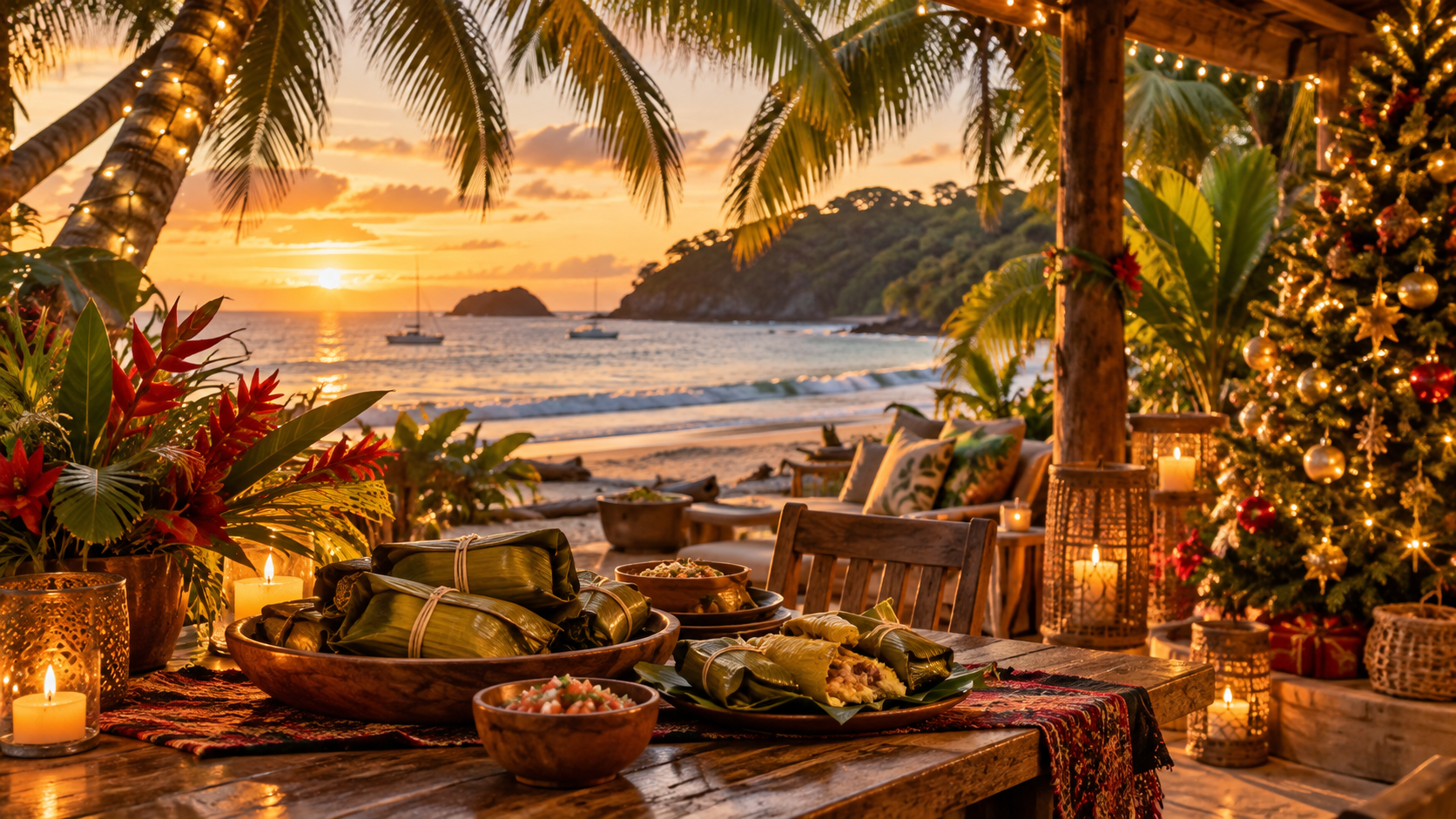
Christmas trees. Family dinners. Church services. Gifts. Lights hanging from houses.
So far, Christmas in Costa Rica may sound pretty familiar to an American visitor.
Then you step outside.
It is warm. Palm trees are moving in the breeze. Someone is making tamales in a kitchen with the windows open. You may spend Christmas morning beside the Pacific Ocean, drive into cool mountain air later in the trip, and hear holiday music playing in a town where nobody is expecting snow.
That contrast is part of the charm.
Costa Rican Christmas traditions combine Catholic customs, family gatherings, local foods, community events, tropical weather, and the general December excitement that comes with the beginning of the country’s popular travel season.
And Christmas is not just one evening.
December develops its own rhythm.
Homes are decorated. Tamales appear everywhere. Schools close for vacation. Families make travel plans. Town centers add lights and events. The weather changes across much of the country as the rainy season gives way to drier conditions.
For a visitor from the United States, it can feel like somebody moved Christmas into summer without removing the Christmas part.
When Does Christmas Season Start in Costa Rica?
There is no official moment when everyone suddenly decides Christmas has begun.
But holiday atmosphere usually starts building before December.
Stores begin displaying decorations. Homes put up trees and nativity scenes. Public spaces add lights. Cultural events and concerts begin appearing on calendars.
By early December, Christmas is hard to miss.
The season continues through Christmas Day and into the New Year period.
For many families, religious observances, school holidays, family travel, and traditional food all overlap during these weeks.
| Period | What You May Notice | Travel Impact |
|---|---|---|
| Late November | Decorations begin appearing | Tourism demand starts rising |
| Early December | Lights, concerts, community events | Good time for festive atmosphere |
| Mid-December | Family preparations and holiday travel | Popular destinations get busier |
| December 24-25 | Main family celebrations | Some businesses change hours or close |
| Late December | Christmas blends into New Year festivities | Peak holiday demand |
Christmas Eve Is a Big Family Night
For many Costa Rican families, December 24 carries as much importance as Christmas Day itself.
Christmas Eve is known as Nochebuena.
Families may gather for a long evening meal, spend time with relatives, exchange gifts, attend church, or stay up until midnight.
The exact routine varies by household.
Some families keep the night strongly religious.
Others treat it mainly as a family celebration.
And plenty do both.
If you are used to an American Christmas built around waking up early on December 25, the late-night rhythm can feel different.
Christmas Eve may be where much of the action happens.
Midnight Mass Remains Important for Many Families
Costa Rica has deep Catholic traditions, and Christmas religious observance remains visible.
Some families attend a late-night or midnight Mass around Christmas Eve.
You may hear the term Misa de Gallo associated with the Christmas service.
Attendance naturally varies.
Not every Costa Rican family celebrates in exactly the same way, and modern Christmas can be highly secular too.
Still, churches remain an important part of Christmas culture in many communities.
The Nativity Scene Can Matter as Much as the Tree
Christmas trees are common.
But another important decoration is the nativity scene, often called a portal or nacimiento.
Families create displays representing the birth of Jesus, sometimes using simple figures and sometimes building elaborate scenes that occupy a large section of a room.
These displays may include Mary, Joseph, the infant Jesus, shepherds, animals, angels, and the Three Wise Men.
Depending on family tradition, figures may be added or positioned at different points during the Christmas season.
This is one of those details visitors might overlook if they are focused only on trees and lights.
And Yes, There Are Christmas Trees
You will see familiar decorated Christmas trees in homes, hotels, stores, restaurants, and public spaces.
Artificial trees are common, especially given the tropical climate.
Lights, ornaments, ribbons, stars, and other decorations look much like those used in the United States.
What changes is the background.
A Christmas tree beside an open window with tropical greenery outside has a slightly different energy from one surrounded by snow.
Tamales Are the Food You Need to Know
If one dish represents christmas in costa rica better than almost anything else, it is the tamal.
Tamales are eaten year-round in parts of Latin America, but in Costa Rica they have a particularly strong Christmas connection.
Families often gather to make large batches.
The process can be social, repetitive, messy, and exactly the kind of food tradition people remember from childhood.
Costa Rican tamales are generally made with corn-based masa and fillings that can include pork or chicken, rice, vegetables, and other ingredients.
The mixture is wrapped in banana leaves and cooked.
Recipes differ from one family to another.
Everyone knows somebody whose version is supposedly the correct version.
This may be the most universal feature of family cooking anywhere.
Making Tamales Is Almost an Event
The word tamaleada may be used for the social process of gathering to prepare tamales.
It is not simply dinner prep.
There can be an assembly-line feeling to it.
One person handles leaves. Another portions masa. Someone adds fillings. Somebody ties packages together.
People talk.
They snack.
They disagree about whether one tamal has too much filling.
Hours pass.
Then a large supply is ready for family meals, visitors, and sharing.
What Else Is Eaten at Christmas?
Tamales get the spotlight, but they are not alone.
Holiday tables vary by family and region.
You may encounter roasted pork, chicken, rice dishes, salads, bread, sweets, and festive drinks.
Rompope is one seasonal drink worth knowing.
It is a creamy holiday beverage related to eggnog traditions and can include alcohol depending on the recipe.
For an American visitor, the easiest comparison is eggnog with a Latin American personality.
Christmas Foods and Drinks to Look For
- Tamales wrapped in banana leaves.
- Rompope during holiday gatherings.
- Roasted pork or other family-style meat dishes.
- Rice dishes and simple salads served with larger meals.
- Seasonal cakes, cookies, and sweets sold in bakeries.
- Coffee, because this is Costa Rica and coffee does not take Christmas off.
Posadas Add a Community Side to Christmas
Christmas celebrations are not limited to private homes.
Posadas can form part of the season in local communities.
These gatherings recall Mary and Joseph seeking shelter before the birth of Jesus.
The format varies, but may include prayer, music, visits between homes, food, and neighborhood participation.
Visitors should remember that these are community and religious traditions rather than tourist shows.
If you happen to be invited, follow the lead of the people hosting you.
San José Gets Properly Festive in December
If you want the strongest urban Christmas atmosphere, San José and the surrounding Central Valley are good places to spend part of December.
Public spaces add holiday lighting.
Concerts and community activities appear throughout the month.
Seasonal performances, cultural programs, and Christmas events create a different experience from the beaches.
December evenings in San José can also feel surprisingly cool.
Not freezing.
But cool enough that a light jacket makes sense.
That helps the Christmas mood a little.
The Festival de la Luz Is One of the Big December Events
San José’s Festival de la Luz is one of the country’s best-known December celebrations.
The event traditionally fills central San José with illuminated floats, marching bands, music, and large crowds.
It is loud.
It is bright.
It is definitely not the evening to expect empty streets downtown.
If you enjoy big community events, it can be one of the most memorable moments of a December trip.
If crowds stress you out, plan accordingly.
Christmas in Costa Rica Comes With Summer Weather
This is where American expectations need adjusting.
December is not winter in the way much of the United States understands the word.
Costa Rica lies in the tropics.
Instead of four standard seasons, weather patterns are usually described in terms of dry and wetter periods, with major regional differences.
Across much of the Pacific side and Central Valley, December marks the transition toward dry season.
That means Christmas often arrives with sunny mornings, greener landscapes left behind by recent rains, and increasingly dry conditions.
But Costa Rica Has Microclimates Everywhere
Do not look at one San José weather icon and assume you understand the whole country.
You do not.
Altitude changes temperature.
Mountains affect rainfall.
The Pacific and Caribbean sides follow different patterns.
A beach can be hot and sunny while a mountain town feels cool and cloudy.
The Caribbean coast also does not follow the same clearly defined December dry-season pattern as much of the Pacific.
In fact, December can be relatively rainy on the Caribbean side.
That catches travelers off guard.
What December Weather Usually Means for Travelers
| Region | December Feel | What to Pack |
|---|---|---|
| Guanacaste | Becoming drier, warm, often windy | Light clothes, sunscreen, hat |
| Central Pacific | Warm with improving dry-season weather | Beachwear plus light rain layer |
| Central Valley | Pleasant days, cooler evenings | Light clothing plus jacket |
| Highlands | Cooler, especially mornings and nights | Layers and wind protection |
| Caribbean Coast | Warm but potentially rainy | Quick-dry clothes and rain jacket |
Christmas on the Beach Is Completely Normal
If your ideal December 25 involves sand instead of snow, Costa Rica makes that easy.
Guanacaste and Pacific beach towns become especially popular during the holiday period.
Tamarindo, Nosara, Playa Conchal, Manuel Antonio, Jacó, Santa Teresa, and other coastal destinations attract both international visitors and Costa Rican families.
You might eat Christmas dinner in shorts.
You might wake up and surf.
You might spend the afternoon swimming.
It feels strange for about ten minutes.
Then it feels fantastic.
The Catch Is That Everyone Else Had the Same Idea
Christmas overlaps with one of Costa Rica’s busiest travel periods.
Domestic vacations and international high season come together.
Popular hotels can fill early.
Beach rentals become harder to find.
Rental cars cost more.
Well-known national parks and tours can become busy.
December 20 through early January is not the time to build an entire trip by arriving somewhere and asking what is available.
Maybe that works.
Maybe your romantic jungle lodge becomes a room beside a highway.
Book Early for Christmas Week
- Reserve popular hotels well ahead of the trip.
- Book rental cars early, especially if you need an automatic transmission or larger vehicle.
- Reserve major tours and national park visits where advance booking is required.
- Confirm restaurant plans for Christmas Eve and Christmas Day.
- Leave extra driving time around busy travel dates.
- Do not assume every small business will keep normal holiday hours.
December 25 Is an Official Holiday
Christmas Day is an official holiday in Costa Rica.
That means travelers should expect some businesses, government offices, banks, and services to close or reduce hours.
Tourist hotels and major resort restaurants may remain active because, well, tourists still need breakfast.
Smaller local businesses can be more variable.
Plan ahead if you need groceries, transportation arrangements, medication, or a specific meal.
Do not wait until 8 p.m. on Christmas Day to discover that your detailed restaurant plan consisted entirely of optimism.
Christmas Eve Hours Can Also Be Different
December 24 is not exactly a normal business day either.
Families want to go home.
Restaurants may close earlier than usual.
Some stores shorten operating hours.
Transport services may thin out later in the evening depending on location.
If you are staying outside a major hotel or resort, ask about holiday logistics in advance.
Should You Spend Christmas in San José?
San José is often treated as a place to leave immediately after landing.
During Christmas season, it deserves a bit more consideration.
The city offers festive decorations, cultural events, churches, restaurants, markets, museums, and access to Central Valley traditions.
You also see more of everyday Costa Rican Christmas life than you would inside a beach resort.
One or two nights can work well.
Spend the entire vacation there?
Probably not unless urban culture is your main interest.
San José Plus the Beach Makes More Sense
A balanced holiday trip could start with two nights around the Central Valley.
See seasonal events.
Eat tamales.
Walk through city neighborhoods.
Then move to the Pacific coast for Christmas or New Year.
You get both versions of the season.
City Christmas and tropical Christmas.
Arenal Feels Different Again
La Fortuna and the Arenal region provide another December option.
The area is known for volcanic scenery, hot springs, rainforest, waterfalls, and adventure activities.
Christmas here feels less beachy and more green.
Rain can still happen, because tropical weather is not a signed contract.
But December travel often coincides with improving conditions across much of the country.
And sitting in a hot spring on Christmas week is not a bad alternative to sitting beside a fireplace.
Monteverde Can Actually Feel Chilly
People hear Costa Rica and pack only tank tops.
Then Monteverde teaches them a lesson.
The cloud-forest region sits at higher elevation.
Wind, mist, and cooler temperatures can make evenings feel surprisingly fresh in December.
A fleece or light jacket is useful.
The forests look especially atmospheric when clouds move through the trees.
If your idea of Christmas requires at least some cool weather, Monteverde is one of the easiest ways to get it without leaving the tropics.
December Trade Winds Are Part of the Experience
Northern trade winds can become noticeable in December, particularly in the Central Valley and northwestern regions.
They make some days feel pleasantly fresh.
They can also become strong.
If you are heading toward mountain viewpoints or exposed areas, that lightweight jacket you nearly left at home starts making sense.
Christmas Travel Is Expensive by Costa Rican Standards
Costa Rica is not automatically a cheap destination.
And Christmas is definitely not its cheapest period.
International demand rises.
Domestic travel rises.
Beach accommodations fill.
Rental vehicles become scarce.
Popular tours sell well.
If saving money matters more than Christmas atmosphere, early December can be a smarter compromise.
You still get holiday decorations and many seasonal events, but you may avoid some of the extreme Christmas-to-New-Year demand.
Early December Is the Underrated Option
This may be the sweet spot for some travelers.
Christmas lights are already appearing.
Tamales are definitely happening.
Public events begin filling calendars.
Landscapes remain green from the rainy season.
The Pacific weather is moving toward the drier part of the year.
Yet you are not fully inside the late-December peak.
If your schedule is flexible, look at roughly the first half of December.
New Year’s Arrives Fast After Christmas
Christmas week does not really calm down afterward.
New Year’s celebrations arrive immediately.
Beach towns stay active.
Hotels remain busy.
Families continue traveling.
Restaurants and bars may plan special events.
If you are staying through December 31, assume you need reservations for anything you care strongly about.
Gift Giving Varies by Family
Modern Costa Rican Christmas includes gift exchange just as it does in many other countries.
Children may receive toys and families exchange presents.
The timing and family traditions vary.
Some gifts appear around Christmas Eve or Christmas Day.
Religious traditions connected with the Christ Child or Three Kings may also influence how individual families frame the season.
There is no one universal script.
What Is “Pura Vida Christmas” Actually Like?
“Pura vida” is the phrase visitors learn before they have even found their hotel.
It can mean hello, goodbye, everything is good, thank you, or a general expression of a positive outlook depending on context.
During Christmas, the phrase fits surprisingly well.
Family meals are long.
Schedules loosen.
People visit relatives.
Food gets shared.
The weather encourages life outside.
Christmas may feel less visually wintery than in the United States, but it does not feel less festive.
What Should Americans Expect to Feel Different?
- No snow in ordinary lowland Christmas settings.
- Christmas meals may center heavily on tamales rather than turkey.
- Christmas Eve can feel more important than Christmas morning.
- Family gatherings may run very late.
- Outdoor public celebrations are easy because December weather is often pleasant.
- Beach travel is part of Christmas vacation culture.
- Businesses may adjust schedules around December 24 and 25.
And What Will Feel Surprisingly Familiar?
Family.
Food.
Music.
Lights.
Kids being excited about gifts.
Parents trying to organize everyone.
Relatives asking questions you hoped they would not ask.
Some Christmas traditions appear different until you notice that the basic family chaos is international.
Christmas Markets Are Not the German Kind
If you are imagining rows of wooden stalls, mulled wine, snow, and heavy winter coats, adjust expectations.
Costa Rica has holiday fairs, markets, food events, community activities, and seasonal vendors.
But the Central European Christmas-market model is not the defining holiday tradition.
The atmosphere is local and tropical.
Think food, crafts, lights, concerts, family crowds, and warm evenings.
What Should You Pack for Christmas in Costa Rica?
Pack for several climates if you are moving around.
The beach and the cloud forest do not share a wardrobe.
- Lightweight summer clothes for lowland and beach areas.
- Swimsuit and sun protection.
- Comfortable walking shoes for parks and towns.
- Light rain jacket because December is still transitional in some regions.
- Warm layer for Monteverde, volcano areas, and cool Central Valley evenings.
- Insect repellent for tropical regions.
- One nicer outfit if you plan a Christmas Eve dinner or church visit.
Do You Need Reservations for Christmas Dinner?
If you are staying at a resort, the hotel may organize a special Christmas meal.
Independent restaurants are less predictable.
Some operate normally.
Some offer special menus.
Others close so staff can spend time with their families.
Ask in advance.
This is especially important in small beach communities and mountain towns.
A backup bag of chips does not count as a festive dining plan.
A Good Seven-Day Christmas Trip
If you have one week, do not attempt to cross the entire country.
A simple Pacific-side route works nicely in December.
Spend one or two nights in the Central Valley.
Continue to La Fortuna or Monteverde for nature.
Finish with several nights on the Pacific coast.
That creates a mix of Christmas atmosphere, tropical forest, adventure, and beach time.
With ten days, you can slow everything down.
A Sample Christmas Route
Here is a comfortable outline rather than a race:
Days 1-2: San José or Central Valley for city culture, food, lights, and seasonal events.
Days 3-4: La Fortuna for hot springs, volcano scenery, and rainforest activities.
Days 5-7: Pacific coast for Christmas on the beach.
If you have extra days, extend the beach portion instead of adding another four-hour transfer.
Your holiday should include some actual holiday.
Respect the Celebration as a Local Tradition
Christmas in Costa Rica is not just a travel theme.
It is family time.
It is religious time for many people.
It is one of the year’s major social periods.
If you attend a church service, dress appropriately and avoid treating worship as entertainment.
If you are invited into a home, ask what you can bring.
If someone offers you homemade tamales, take that seriously.
You may be receiving several hours of somebody’s family labor wrapped in a banana leaf.
FAQ About Christmas in Costa Rica
How is Christmas celebrated in Costa Rica?
Christmas commonly includes family gatherings, tamales, nativity scenes, decorations, church services, gifts, concerts, community events, and celebrations on Christmas Eve and Christmas Day.
What do Costa Ricans eat for Christmas?
Tamales are one of the strongest Christmas food traditions. Families may also serve roasted meats, rice dishes, salads, sweets, coffee, and seasonal drinks such as rompope.
Is Christmas Day a holiday in Costa Rica?
Yes. December 25 is an official paid public holiday in Costa Rica, so some businesses and services may close or operate reduced hours.
What is the weather like in Costa Rica at Christmas?
December marks the transition into the dry season across much of the Pacific side and Central Valley. Beaches are warm, while higher areas can be cool. The Caribbean side can remain much wetter.
Is Costa Rica crowded at Christmas?
Yes, many popular destinations become busy from mid-December through New Year because international high season overlaps with domestic holiday travel. Book popular lodging and transportation early.
Can you spend Christmas on the beach in Costa Rica?
Absolutely. Pacific beach destinations such as those in Guanacaste and the Central Pacific are popular Christmas choices, especially as the dry season begins.
Is December a good time to visit Costa Rica?
Yes. December is one of the most popular months, with improving dry-season weather in many regions, green landscapes, Christmas celebrations, and excellent outdoor travel conditions. Prices and crowds are higher near Christmas and New Year.
Christmas in Costa Rica Is Best When You Stop Looking for Snow
The first thing to understand is simple.
Costa Rica is not trying to recreate a northern Christmas.
It has its own version.
The tree can be there.
The lights can be there.
The Mass, gifts, family dinner, and Christmas music can all be there.
But so can palm trees.
So can surfboards.
So can a 85-degree afternoon beside the Pacific.
That does not make the holiday feel less like Christmas.
It simply changes the scenery.
The real center of christmas in costa rica is not the weather anyway.
It is the family table.
It is someone unfolding banana leaves around a tamal.
It is relatives arriving with food.
It is children waiting for gifts.
It is churches preparing for Christmas services.
It is parks and streets filling with lights.
It is people getting out of work and school and trying to figure out where the entire family is going to fit.
Visitors get a second layer on top of that.
December also happens to be one of the most attractive travel periods for much of Costa Rica.
On the Pacific side, the rainy season is giving way to drier weather.
Landscapes are still green.
The beach season is getting serious.
National parks are popular.
Mountain regions provide cooler air when you want a break from tropical heat.
You can spend one part of the trip hiking near a volcano and another barefoot beside the ocean.
And that is why a Costa Rican Christmas can work especially well for American travelers.
You do not have to choose between “Christmas trip” and “tropical vacation.”
You get both.
The main challenge is logistics.
Christmas and New Year are busy.
Book the hotel you really want.
Book transportation early.
Ask what your hotel is doing on December 24 and 25.
Do not assume every restaurant will operate normal hours.
And if you are moving around the country, remember that Costa Rica is small on the map but slow on the road.
Four places in five days is not an adventure.
It is a scheduling problem.
Slow down.
Eat the tamal.
Spend a morning at the beach.
Take a jacket into the mountains.
Listen to the Christmas music that sounds slightly strange when tropical birds are calling outside.
And do not worry about whether it feels enough like December back home.
That is the point.
Leave a Reply