
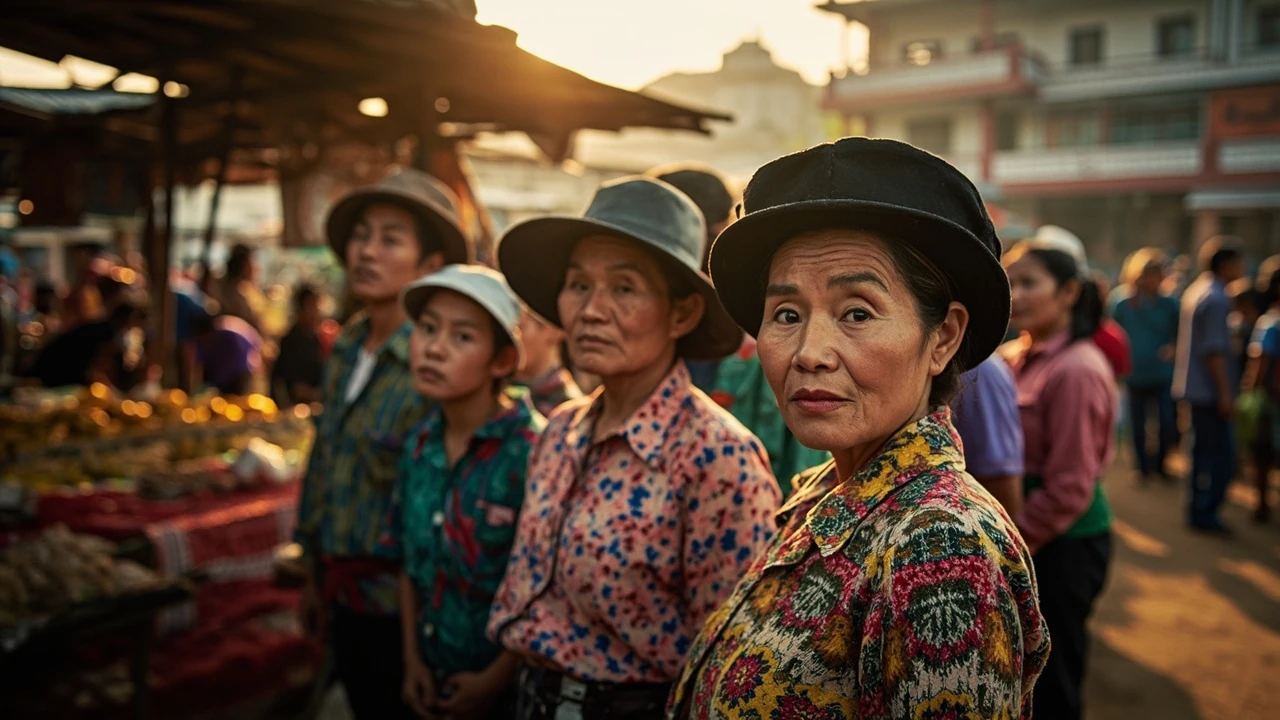
What are people from Laos called?
People from Laos are commonly called Lao people, while Laotian is also a widely understood term and is often used as an adjective. The answer depends on whether a speaker means citizens of Laos, members of the Lao ethnic group, or both. These terms overlap in everyday English, but they are not always interchangeable in every context.
A traveler booking a flight, asking about a nationality, studying the country’s languages, or meeting residents may encounter different labels. Some speakers use “Lao” as a noun, some prefer “Laotian,” and others use a specific ethnic or regional identity when that is more meaningful. Understanding those distinctions makes conversation more precise without turning a simple cultural question into an interrogation.
- Lao people is the clearest general English term for people associated with Laos as a country and its principal ethnic group.
- Laotian is an accepted English demonym, useful as both a noun and an adjective.
- Lao can describe a person, the Lao language, a place, food, culture, or something associated with the country.
- A Lao citizen is the clearest wording when legal nationality, passport status, or civic membership is the point.
- Ethnic-group names such as Akha, Hmong, or Tai Dam may be more appropriate for a person whose specific community is relevant.
The key distinction is between a country, a nationality, a language, and an ethnic community. Laos is the country. Lao is part of its official language name and is also the identity of its largest ethnic group. “Laotian” usually serves as the English counterpart. A person can be a citizen of Laos without belonging to the ethnic group known as Lao, which is why careful writers use the broader or more specific term depending on what they are discussing.
Lao, Laotian, or Lao people: which term is best?
For most travel questions, “Lao people” is the most neutral and direct answer. It works as a noun, sounds natural in sentences such as “Lao people are known for their welcoming approach to visitors,” and avoids making nationality sound like an ethnic category. “Laotian” is also correct, and many readers will expect to see it in older guides, university materials, or travel resources.
The two terms are not competitors in a strict sense. Their frequency and tone can vary by speaker, region, and context. A person may describe themselves as Lao, refer to another person as a Laotian, and use “Lao culture” for traditions associated with the country. No one should infer that a person is offended by one of these terms solely because another term exists.
| Term | Common grammatical use | Meaning in context | Best use |
|---|---|---|---|
| Lao people | Plural noun | People belonging to the Lao ethnic group or, more broadly, people from the country of Laos | General writing, introductions, and travel conversations |
| Laotian | Singular or plural noun; adjective | English demonym associated with Laos or the Lao people | “A Laotian guide,” “Laotian cuisine,” or “Laotian citizens” |
| Lao | Noun, adjective, or part of compound words | A person of Lao identity; something connected with Laos, the Lao people, or the Lao language | “A Lao artist,” “Lao language,” “Lao New Year,” or “the Lao community” |
| Citizen of Laos | Singular or plural noun | Legal nationality or citizenship | Passports, immigration, residence rights, and civic questions |
| Lao national | Singular or plural noun; adjective | National belonging to Laos | Sports, diplomacy, and formal or national contexts |
| A specific ethnic-group name | Usually an adjective before a noun, or a collective noun | Membership in or connection with a particular community | When ethnicity, regional heritage, or community identity matters |
Capitalization is useful because it separates the named language and people from an adjective used in a general sentence. “The Lao language is tonal,” “The Lao people,” and “Lao culture” all use a capital L. A lowercase “lao” can mean “burned” or “to burn” in other contexts, so readers should not lowercase the demonym merely because it appears after a verb.
Plural forms follow standard English rules. “Lao people” is already plural, so the sentence should say “Lao people are,” not “Lao peoples are,” unless a writer is deliberately discussing separate communities. “Laotians” can be used as a straightforward plural, although “Lao people” is often the more natural choice in formal writing.
Is a Lao citizen always part of the Lao ethnic group?
No. Laos is home to many ethnic communities, and national citizenship does not automatically identify a person’s ethnic heritage. The distinction matters because “Lao” can refer both to the country’s majority ethnic group and, in broader everyday usage, to people from the country. In a sentence about citizenship, nationality, or a passport, “Lao citizen” avoids assumptions about ethnicity.
BBC Travel’s account of Laos’ collective approach to healthcare gives a useful example of why this distinction is meaningful. The feature discusses the baci or su khuan ceremony and notes that beliefs and customs can vary among the country’s ethnic groups. The same general custom may be practiced in many communities, but its form and interpretation can differ.
A writer describing one person should avoid guessing which community they belong to. Appearance, surname, location, dress, language, or the language a person uses at home may not be reliable evidence. The respectful approach is simple:
- Use “Lao people” or “Laotian” when discussing residents or citizens of Laos in general.
- Use “a citizen of Laos” when nationality is the relevant fact.
- Use a specific ethnic name only when the person or a reliable source has stated it.
- Ask neutrally if specific cultural or linguistic background genuinely matters to the conversation.
- Avoid treating one village tradition, language, or belief as representative of every community in Laos.
The distinction also affects travel writing. A guide to a market in Luang Prabang might discuss a practice relevant to local Lao communities, while an article about the northern highlands may need to distinguish among several communities. Accurate terms show respect for people whose identities are more varied than a single national label can convey.
How does the Lao language fit into the question?
The Lao language is spoken by the Lao ethnic group and is an official language of Laos. It belongs to the Tai language family and is closely related to other regional languages, including Thai and Isan, although related languages are not interchangeable. Calling a person “Lao” because they speak Lao can therefore blur two different facts: a person’s identity and the language they use.
An For additional context, overview of Lao people and ethnic groups is useful for checking basic facts about the country’s population, history, and regional distribution. A travel reference can then add the context that matters in person: which languages visitors may encounter in a specific area and how pronunciation or vocabulary varies.
For a traveler, the distinction is often practical rather than academic. Hotel staff, guides, restaurant workers, and drivers may use Lao alongside English, Chinese, Vietnamese, or other regional languages. Signs may appear in Lao and one or more additional languages. Asking someone’s nationality in the form “Are you Lao?” can be understood, but it may be read as asking about ethnicity. If the purpose is to know which language someone prefers, it is better to ask directly:
- “Which language are you most comfortable using?”
- “Do you prefer to practice English or have me use another language?”
- “Would you like me to repeat that more slowly?”
- “Is there a local name for this food, ingredient, ceremony, or place?”
Lao script is also an important visual marker of the country. It is an abugida, meaning that consonant characters can carry vowel information when written in combination. Visitors do not need to learn the writing system to use the term “Lao” correctly, but recognizing the script can prevent confusion with neighboring languages that use similar characters.
Language should never be treated as a reliable test of nationality. Laos borders several countries, and people cross borders for work, education, family, tourism, and commerce. A visitor may meet a Lao speaker in Thailand, a Thai speaker in Laos, or a multilingual resident who uses different languages in different settings. The person’s preferred language and self-description are more informative than a visual guess.
What do regional and ethnic identities add to the answer?
“For additional context, Lao” answers the broad question, but it does not describe every person or community in Laos. Some residents identify primarily through a specific ethnic group, regional heritage, local community, or family history. This does not make the national term wrong. It means that additional context may be needed when discussing language, traditions, food, migration, or a particular place.
Laos includes communities with distinct histories and cultural practices, including Tai groups, Hmong communities, Akha communities, and Tai Dam communities, among others. Their names should not be used as decorative alternatives to “Lao.” Each label points to a real community, not simply a different way of saying the same thing.
| Identity label | What it communicates | What it should not imply |
|---|---|---|
| Lao people | General connection to Laos and commonly the principal ethnic identity associated with the country | That every person in Laos shares identical ancestry, customs, or language |
| Laotian | English-language national or ethnic demonym | That a person has no ties to a more specific community |
| Citizen of Laos | Nationality or legal membership in the country | That ethnicity can be inferred automatically |
| Akha, Hmong, Tai Dam, or another community name | Specific ethnic or cultural identity when appropriately used | That the person should be separated from the rest of society or described only by that identity |
| Regional identity | Connection to a province, city, valley, border area, or cultural region | That every person in that region has the same heritage |
Some regional identities overlap with ethnic identities, while others describe geography, migration, dialect, foodways, or local belonging. A person may identify as Lao and also feel strongly connected to a particular province or diaspora community. These identities do not need to compete. Good writing can mention more than one when it does so accurately and without forcing a person to choose a single label.
That is also why terms such as “Lao culture” need context. They can refer to customs associated with the Lao people, to a national culture shared across communities, or simply to cultural material found in Laos. If an article focuses on one ceremony, building style, dish, or performance, naming the relevant community or location gives readers a clearer picture.
For travelers, the most useful habit is to preserve the specificity a host chooses. Listen for how people describe themselves. A guide may say they are “from Luang Prabang,” a vendor may identify with a particular community, and a hotel worker may simply say they are “Lao.” Repeating the person’s own wording is respectful and more precise than replacing it with a broad label.
How should travelers use these terms in conversation?
Most travelers do not need a long explanation to participate respectfully in normal interaction. They need a few reliable phrases and an understanding of when not to make assumptions. “Lao people” and “Laotian” will be understood in many English-speaking contexts, while “a citizen of Laos” is safest for official questions.
When speaking to someone face to face, ordinary courtesy remains more important than displaying a specialized vocabulary. A simple “What do you call yourself?” can be more personal than immediately asking which ethnic group someone belongs to. If you make a mistake, acknowledge it briefly, correct it, and continue without making the exchange about your own embarrassment.
Useful conversation patterns include:
- “Are you from Laos?” to ask about origin without assuming ethnicity.
- “What is your hometown?” to learn a place-based identity without making ethnicity the subject.
- “Are you Lao, or would you prefer another term?” when a personal and relevant identity question requires clarification.
- “How do you pronounce this name?” to check the correct form of a personal or community name.
- “Is this custom specific to this community, or is it common here?” to learn without flattening local differences.
Physical descriptions can feel intrusive when used to guess identity. Saying that someone “looks Lao” may draw on visible stereotypes rather than anything the person has told you. If a term is necessary for service or navigation, describe the relevant need instead: a language preference, place of origin, or correct spelling.
Digital communication deserves similar care. When labeling a photograph, check whether a caption identifies a person and whether the context permits naming a specific community. A caption such as “a Lao woman demonstrates a traditional craft” may be inaccurate if the maker belongs to another community. “A craftswoman working at a market in Luang Prabang” is often more precise. Alt text should describe what is visible in the image rather than assign an identity that cannot be confirmed.
For official matters, use “Lao” for the country and “Lao citizen” or “national of Laos” for the person. This keeps nationality distinct from ethnicity and avoids implying that a legal status determines cultural identity.
What are common mistakes and clearer alternatives?
Most mistakes do not come from malice. They come from quick assumptions, machine translation, or the habit of treating nearby countries and cultures as interchangeable. Replacing those habits with precise wording usually takes only a few adjustments.
| Less precise wording | Problem | Clearer wording |
|---|---|---|
| “They are called Laotians, not Lao.” | Presents one of two accepted English terms as the only correct answer | “Lao people” is the most direct general term, while “Laotian” is also widely used. |
| “All Lao people speak Lao and follow the same traditions.” | Ignores ethnic, regional, linguistic, and individual diversity | “Many people in Laos speak Lao, but the country includes many communities and regional experiences.” |
| “A person who looks Lao must be from Laos.” | Treats appearance as proof of nationality or ethnicity | Ask the person about their origin or preferred identity. |
| “Laos is a Thai country.” | Conflates related languages with national identity | “The Lao language is related to Thai, but Laos is a separate country with its own national and cultural history.” |
| “Everyone in Laos is Buddhist in the same way.” | Overgeneralizes religious belief and ignores variation | Name the specific tradition or community when discussing religious practice. |
| “This is the official Lao dish for every region.” | Presumes one uniform cuisine across a diverse country | “This dish is associated with the Lao community in this area” or “This is a well-known Lao dish.” |
| “Use the Laotian name for the city, province, or village.” | May substitute an English exonym for the locally preferred name | Use the local place name and its established English version when readers need both. |
Machine translation deserves special caution with names. A Lao proper name may be transliterated differently by different systems, and a translation engine can strip tones, introduce unfamiliar surname order, or assign an English equivalent that locals do not use. For an address, booking, or direct introduction, copy the spelling from a map, official listing, passport, or the person’s own message.
Another common error is using a broad national label to avoid learning a place name. Referring to everyone and everything as simply “Laotian” can obscure local distinctions that matter to residents. If a temple, river, market, meal, or community has a local name, preserve it and explain it where useful.
Travel writing also improves when it distinguishes observation from inference. “The person is wearing a patterned sinh” describes clothing; “The person is Hmong” identifies a community, which the writer may not know. Likewise, “The ceremony is called a baci” accurately names a practice, while saying that every ceremony follows the same pattern requires more caution. Specificity should come from evidence, not visual guesswork.
A quick reference for trip planning and respectful conversation
A compact reference makes the terminology easier to use. First decide whether the subject is a person, a citizen, an ethnic community, a language, or a cultural feature. Then choose the form that answers the actual question. Most conversations require only “Lao people,” “Laotian,” or “a citizen of Laos.”
- For general reference to residents of the country: use “the Lao people,” “people from Laos,” or “Laotians,” depending on sentence flow.
- For nationality: use “a citizen of Laos,” “a Lao national,” or the adjective “Laotian.”
- For the principal ethnic group: use “the Lao ethnic group” or “Lao people,” particularly when contrasting it with other communities in Laos.
- For a specific community: use the community’s own name when it is known and relevant.
- For the language: say “the Lao language,” not “the Laotian language” unless quoting a particular source.
- For culture: use “Lao culture” for a general association and name a region or community for more specific traditions.
- For people encountered during a trip: ask rather than assume, and use the wording they prefer.
- For images and captions: describe what is visible, and avoid assigning ethnicity unless it is confirmed.
The broader world of destination writing often uses similar lessons. Geography can shape how people describe themselves, and different regions may present names and cultural histories in different ways. For comparison, this site’s explanation of Italy’s history did not begin with the Roman Empire shows why modern identity should not be reduced to a famous historical shorthand. A practical guide to Sri Lanka beaches change depending on which coast you pick similarly shows why a shared country name does not erase regional differences. Those same principles apply to Laos: one national label can be useful, but it should not replace more precise local knowledge.
Before using the term in a published article, caption, itinerary, or conversation, ask a simple editing question: “What exactly am I identifying?” If the answer is citizenship, name citizenship. If it is the principal ethnic group, say so. If it is a community with its own identity, use that identity. If the answer is simply that the person is from Laos, then “Lao people” or “Laotian” is enough.
Frequently asked questions
What are people from Laos called?
People from Laos are commonly called Lao people. The term Laotian is also correct in English and works as both a noun and an adjective. For official or legal contexts, “a citizen of Laos” makes the nationality explicit.
What is the difference between Lao and Laotian?
Both terms can refer to people associated with Laos. “Lao people” is often the most direct general wording and is also the standard name for the country’s principal ethnic group. “Laotian” is an established English demonym. Neither word is a substitute for asking someone which specific ethnic or regional identity they prefer.
Are all people from Laos Lao?
No. Laos is a multiethnic country, and citizens may belong to many different communities. A citizen of Laos is not automatically a member of the ethnic group known as Lao. Writers should distinguish nationality from ethnicity unless a person has identified a more specific identity.
Is “Laotian” offensive?
No. “Laotian” is a widely recognized English term and is not inherently offensive. Some people may prefer “Lao people,” while others may use a specific ethnic or regional name. The respectful practice is to use the term the individual or community prefers.
Do Lao people speak Lao?
Many do, but language use varies by person, community, and location. Lao is an official language of Laos, while multilingualism and the use of other regional or national languages are common. Avoid assuming that a person’s nationality tells you exactly which language they speak best.
What should I call the language of Laos?
The correct English name is Lao language. “Laotian” can function as an adjective, but “Lao language” is the conventional name. Lao is written with its own script and is related to several regional Tai languages, including Thai and Isan.
Can someone be a Lao citizen but not identify as ethnically Lao?
Yes. Citizenship describes membership in the nation of Laos, while ethnicity describes community or cultural identity. The two can overlap, but they are not the same. Use “Lao citizen” for nationality and a specific community name only when it has been appropriately established.
What should I ask if I am unsure of someone’s identity?
Ask politely and only when the answer is relevant. “Are you from Laos?” or “What is your hometown?” are usually less intrusive than asking someone to identify an ethnic group from appearance. If a personal introduction requires clarification, you can ask whether “Lao” is the term they prefer or whether they identify with another community.
What is the best term to use in a travel guide?
Use Lao people for a general reference and Lao citizen when discussing nationality. Identify a particular community, region, or tradition when the subject warrants it. Also use local place names and preferred personal names rather than replacing them with broad national labels.




Leave a Reply