
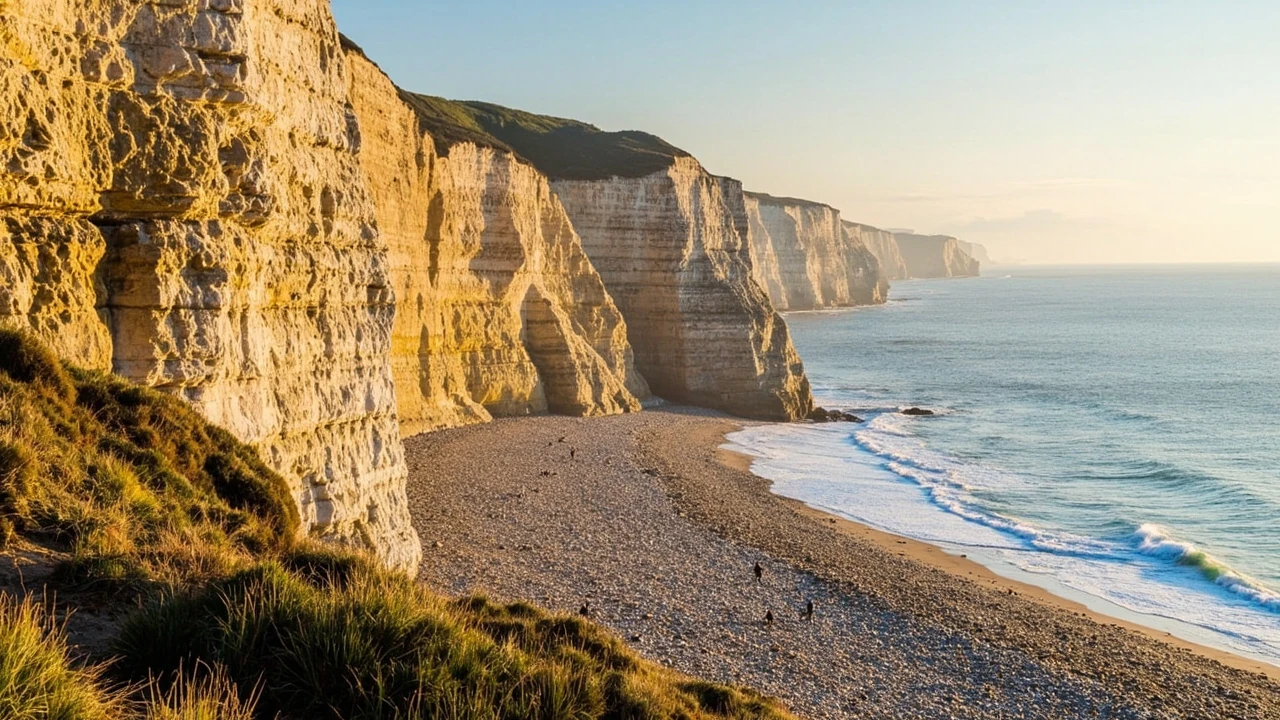
Jurassic Coast England: What to see and how to plan the trip
A visit to the Jurassic Coast England can combine dramatic cliffs, fossil-rich beaches, historic seaside towns, and long stretches of open walking path. The coastline runs through eastern Devon and Dorset, but it is more useful to think of it as a chain of distinct places rather than one continuous attraction. Lyme Regis is convenient for fossil history and town-based meals, Lulworth is a memorable stop for its cove and folded rocks, and Durdle Door provides a famous arch above a sheltered beach. Farther west, the landscape shifts toward red sandstone, gravel, and taller coastal viewpoints.
This guide focuses on the practical decision most visitors need: how to choose a route, which stops deserve extra time, and what to bring for a coast that can change quickly with the weather. The landscape is geologically remarkable because erosion exposes rock layers formed across roughly 185 million years. As the cliffs crumble and landslides occur, older sediments and fossils appear at the shoreline. That process makes the coast visually varied, but it also means that paths, beaches, and viewpoints may be affected by rockfall, maintenance, tides, or temporary closures.
Plan around the parts of the route you most want to see instead of trying to drive every mile of the coast in one day. Distances may look short on a map, but narrow lanes, coastal settlements, parking limits, and walking routes can turn a short transfer into a significant part of the day. A clear plan also matters because the best beach or cliff experience may be entirely different from the one beside a convenient car park.
How long to spend and which places to choose
Most travelers need at least two full days to see the headline landmarks without spending most of their time in transit. Three days allow a more relaxed rhythm, particularly when the plan includes walks, fossil hunting, boat-related activities, or a stop in several towns. A single day can work if your priority is one particular location, but choosing among Lyme Regis, Lulworth, and the western cliffs can mean sacrificing the others.
- One day: Choose one geographic area and avoid crossing the entire coast. Lyme Regis and Charmouth suit fossil enthusiasts; Lulworth and Durdle Door suit visitors focused on landforms and scenic walks; Exmouth and the western end suit beach time and easier vehicle access.
- Two days: Divide the route into a western section and an eastern section, or pair Lyme Regis with Lulworth and save the remaining landmarks for another day.
- Three days: Use one full day in the west, one for Lyme Regis and Charmouth, and one for Lulworth, Portland, and Durdle Door. Add buffer time for weather rather than filling every hour.
- Four days or more: Add slower travel days, coastal walks, and nearby inland stops. The value comes from seeing the coast at more than one pace, not from adding distant destinations that require substantial driving.
The best season depends on whether you prioritize walking, fossil collecting, or relaxed beach weather. Spring and early autumn can be comfortable for many outdoor activities, while summer brings larger crowds and a fuller calendar of local events. Winter offers quieter conditions but also shorter daylight, frequent rain, rough seas, and more weather-related closures. Check current attraction access and local conditions close to the trip rather than relying on a fixed travel rule.
A one-word answer is also insufficient because several strands of this coast are privately managed, publicly accessible, or subject to different local restrictions. National park authorities, town councils, landowners, and transport operators may provide different information. A travel plan works best when it identifies the desired experience first, then checks the current official guidance for each specific stop.
| Trip length | Best fit | Suggested focus |
|---|---|---|
| 1 day | A single landmark or short walk | Choose Lyme Regis, Lulworth, Durdle Door, or Exmouth rather than combining distant sections. |
| 2 days | First-time visitors | Pair western cliffs with Lyme Regis and Charmouth, or focus on Lulworth and Durdle Door. |
| 3 days | Hiking and geology | Divide the coast geographically and reserve one flexible day for weather. |
| 4+ days | Slow travel and walks | Add inland villages, extended coastal paths, and time for repeated visits to favorite beaches. |
Main stops from Exmouth to Studland Bay
The official World Heritage area stretches for about 96 miles, or 154 kilometers, from the cliffs near Exmouth in East Devon to the Old Harry Rocks area near Swanage in Dorset. That distance makes a complete crossing impractical for many short trips. The following stops are selected for their landscapes, geological features, town appeal, and role in a coastal route.
| Stop | What makes it useful | Plan with care |
|---|---|---|
| Exmouth and Orcombe Point | Eastern gateway, broad beach, red cliffs, and the Geoneedle at Orcombe Point. | Use this as the western end of the route rather than treating it as a complete attraction by itself. |
| Sidmouth and Branscombe | Seaside scenery, a long wooded valley behind the coast, and striking red sandstone farther east. | Valley and cove walks require extra time beyond a brief photo stop. |
| Lyme Regis | Historic seaside town, famous fossil heritage, museum collections, and access to nearby cliffs. | Allow time for the town, the Cobb, and the shoreline rather than only stopping for lunch. |
| Charmouth | Jurassic clay and shale cliffs, a village center close to the beach, and easily accessible fossil-bearing layers. | Check cliff condition, tide, and local collecting guidance before searching exposed beds. |
| Golden Cap | One of the coast’s highest points, with views across the landscape and steep walking routes. | Do not treat the elevation as a short stroll; route difficulty and muddy surfaces need consideration. |
| West Bay | Dramatic golden cliffs, a prominent headland, and a useful coastal outlook. | The landscape changes around the headland, and the upper paths can be exposed to wind. |
| Lulworth Cove | A horseshoe-shaped cove cut through resistant Portland stone, with distinctive rock folding nearby. | Beach access and parking can be busy. Visit viewpoints and the cove without rushing through both. |
| Durdle Door | A natural limestone arch and a popular beach reached by a downhill coastal path. | The return climb is demanding, especially in wet or hot conditions. |
| Portland and Chesil Beach | Historic quarry landscapes, a long barrier beach, and views toward the Isle of Portland. | The area is extensive; identify the specific cove, shore section, or inland site before setting off. |
| Studland Bay and Old Harry Rocks | Chalk scenery, sea stacks, and the eastern end of the World Heritage Site. | Old Harry lies close to Studland and Swanage, so the final section can be combined with one of those bases. |
These places also provide the background to the Jurassic Coast World Heritage Site, whose exposed strata span the Triassic, Jurassic, and Cretaceous periods. Learning the broad sequence before visiting makes stops easier to interpret: red rocks dominate parts of East Devon, while darker clay and shale appear around Lyme Regis and Charmouth, and pale limestone dominates the Portland area.
What to look for in the cliffs and beaches
The coast’s defining feature is visible geology. The rocks are not simply decorative backdrops to the sea. Erosion has revealed an almost continuous sequence of sediments, and different beds contain different remains of the organisms that lived when those sediments were deposited. This makes the landscape readable from the beach if you know what to look for.
Ammonites are among the most recognizable fossils and can be found in several rock types, although their presence does not mean every fossil-shaped object is worth keeping. The cliffs around Lyme Regis have been associated with Mary Anning’s pioneering discoveries, including the first complete ichthyosaur skeleton found at The Spittles. Fossils from the area include marine reptiles, crustaceans, mollusks, fish, amphibians, insects, and plants.
- Ammonites: Spiral fossils occur in several formations and are useful for identifying the age and environment of a rock layer.
- Trace fossils: Tracks, burrows, and feeding marks may reveal how animals lived even when body fossils are absent.
- Plant material: Carbonized plant fragments and other preserved remains occur in some beds, including the fossil forest around Lulworth Cove.
- Rock textures: Differences in color, grain size, bedding, and resistance reveal changes from desert landscapes to tropical seas and later swamp environments.
- Coastal shapes: Arches, stacks, coves, landslips, and barrier beaches connect the geological story to the scenery visible today.
Do not hammer cliffs or split rocks to look inside. Such activity can damage the evidence the site is known for and may also be prohibited. Collecting rules can vary by location, and some visible fossils may be best observed in place or documented through photographs. The practical approach is to check current local guidance, look closely at loose material rather than breaking the cliff, and leave anything unusual for a local expert or recognized collection to assess.
The rocks also record environmental change across immense spans of time. According to the geological sequence described for the World Heritage area, the region moved from a Triassic desert to a Jurassic tropical sea and then to Cretaceous swamps. Fossils help connect those changing landscapes to actual organisms rather than presenting the cliffs as a series of anonymous layers.
Beaches, coves, and coastal walks
The Jurassic Coast England works best for travelers who enjoy changing viewpoints. A beach can be broad and gently sloped, a cove can sit beneath steep rock, and a path can reveal the same coast from above. Select the type of experience you want before choosing a stop.
For a relaxed beach day, the eastern Devon coast around Exmouth and Sidmouth offers a more conventional seaside setting. Around Charmouth, the beach is more closely tied to the cliffs and fossil landscape. Lulworth Cove and Durdle Door offer more dramatic scenery, but their paths and beach approaches can be demanding. Chesil Beach provides a very different experience, with a long pebble barrier enclosing the Fleet lagoon.
For additional context, Walking the South West Coast Path is one of the clearest ways to experience the coast as a connected landscape, but sections vary enormously. A route through a village or sheltered bay may be gentle, while a cliff ascent or descent can involve uneven ground, steep gradients, mud, and exposure. Tide and weather can alter the feel of a route even when it remains technically open.
- Short, accessible outing: Choose a promenade, beach settlement, viewpoint near a car park, or a short section with minimal elevation change.
- Moderate cliff walk: Add a coastal path with steady climbs and descents, and carry water even if the route appears short.
- Long-distance walk: Build in rest stops, identify the destination and return options, and expect the return leg to feel longer.
- Family walking trip: Favor a circular route with a clear destination, a cafe or town stop, and an escape route if the group tires.
Leave enough time to walk the route rather than only estimate it from the map. A coastal path that looks direct on a screen may include steep steps, gates, uneven surfaces, or a longer path around an obstacle. Local information is especially valuable after rain, when exposed clay can become slippery and muddy.
What to pack for weather, tides, and uneven ground
Weather on this coast can change quickly, and the difference between a sunny coastal scene and a wet cliff path is substantial. Even during a pleasant visit, the exposed shoreline experiences stronger wind than nearby inland areas. Bring layers rather than one heavy coat, and use footwear with good grip. Waterproof outerwear is more useful than an umbrella when walking in coastal wind.
Tides affect access to beaches, coves, rock platforms, and the visibility of exposed fossil beds. Low tide can reveal more of the shore but can also leave a long distance between the water and a cliff base. At high tide, some approaches become narrower or unavailable. Do not base a route on a remembered tide time; check the tide table for the specific date and place.
- Waterproof jacket and wind-resistant layer
- Sturdy shoes with grip, plus a dry pair if walking through damp ground
- Water, snacks, and a small amount of waste storage
- Sun protection for exposed beaches and pale rock
- Charged phone and offline map reference
- Simple first-aid supplies for blisters or minor cuts
- Binoculars if birdwatching, landscape viewing, or watching boats from a distance is important
Keep children close on exposed cliffs and avoid climbing unstable rock. Landslides are common in parts of the Jurassic Coast because erosion weakens the cliffs, and the same process that reveals fossils can also produce falling debris. Stay behind barriers, obey temporary signs, and move away if rockfall or cracking is visible. If a cliff section is closed, choose another viewpoint rather than attempting to bypass the closure.
For wildlife, use binoculars and keep distance from nesting or breeding areas. Dogs must follow current local access rules, which can differ by beach, cliff, and season. Likewise, avoid flying drones without checking land-management restrictions, local regulations, and privacy requirements. These details are easier to confirm before arrival than to resolve after a fine or an accident.
A flexible three-day itinerary
This itinerary is designed to minimize backtracking while leaving room for slow stops. It prioritizes the principal landmarks, but the order can be adjusted according to accommodation, weather, and transport.
| Day | Route | Suggested activities |
|---|---|---|
| Day 1 | Exmouth or Sidmouth to Lyme Regis | Begin at Orcombe Point or the western cliffs, continue through the red and gravel landscapes, then stay in Lyme Regis for the evening. Visit the Cobb and learn about the town’s fossil history. |
| Day 2 | Lyme Regis, Charmouth, and the cliffs toward Golden Cap | Explore the shoreline and a museum, walk toward Charmouth, and continue farther along the coast if conditions and energy allow. Keep the route flexible because weather can make the clifftop paths slippery. |
| Day 3 | Lulworth Cove, Durdle Door, and Portland | Examine the cove and folded rocks, walk toward Durdle Door, and continue to the Portland area if the schedule and transport plan allow. Finish near Chesil Beach or return from a convenient eastern base. |
If only two days are available, prioritize Lyme Regis and Charmouth in one area, then Lulworth and Durdle Door in another. If one day is all you have, choose the place that matters most. Durdle Door is visually iconic, but a visit to Lyme Regis offers a stronger combination of scenery, town atmosphere, and fossil history.
Travel between sections by car is often the most flexible approach for a short visit, although narrow roads and busy coastal parking areas can be frustrating. Rail-based travel can reduce road time for travelers staying near larger transport hubs, but the route still involves local buses, taxis, or walking for the final part of a stop. Check current timetables and service disruptions directly rather than assuming every segment is equally well served.
Who the coast suits—and who may want a different route
The Jurassic Coast England is a strong fit for travelers interested in geology, fossils, coastal scenery, and moderate to challenging walks. It also rewards anyone willing to treat bad weather as a reason to visit a town, museum, viewpoint, or sheltered site instead of forcing a long cliff walk.
Families can find engaging material at several locations, especially where visitors can compare rock layers without needing specialist knowledge. However, a family day should not be built around covering many distant stops. Children may tire quickly on steep paths, and changing weather affects everyone differently. A shorter walk followed by a museum or meal usually produces a better day than a full-distance crossing.
Travelers with limited mobility will find that accessible experiences differ by location. Paved promenades, beach-level areas, town centers, and some viewpoints may work well, while steep cliff paths, uneven beaches, and exposed natural terrain present different obstacles. Contact individual attractions and transport providers about current step-free access, parking availability, and assistance rather than relying on an old general description.
Those seeking polished resorts or a dense schedule of organized attractions may also prefer a different base. This coastline is spread out, and its main attraction is the landscape itself. The best visit rewards curiosity, flexible timing, and an acceptance that the sea, tides, and erosion continually reshape what is visible.
For travelers comparing coastal experiences elsewhere, the coast-by-coast distinctions in Sri Lanka Beaches Change Depending on Which Coast You Pick offer a useful reminder that “beach” can mean very different terrain. The historical context in Italy’s History Did Not Begin With the Roman Empire similarly shows how landscapes acquire meaning through layers of human history, not only natural scenery.
Frequently asked questions
How long does it take to visit the entire Jurassic Coast England?
The World Heritage Site stretches for roughly 96 miles, or 154 kilometers, from Exmouth to Studland Bay. Traveling the entire coast in one day would provide little meaningful sightseeing time. Most visitors should allow two to four days, depending on how much walking they want to do and which landmarks matter most.
What is the best single day trip on the Jurassic Coast England?
Durdle Door is the strongest choice for scenery and a memorable natural arch, especially if the walk to the beach appeals to you. Lyme Regis is a better option for a mixed day of town atmosphere, fossil history, and coastal views. Choose Lulworth if the cove and distinctive folded geology are your priorities.
Can you find fossils along the Jurassic Coast?
Fossils are found in several rock formations, with ammonites among the recognizable examples. Collecting and disturbing rules vary by location, and some beds are fragile or protected. Check local guidance before visiting, do not hammer or split rock, and leave unusual specimens for expert identification.
Is the South West Coast Path suitable for beginners?
Some sections are suitable for beginners, including gentle stretches around towns and sheltered bays, but the full path includes substantial elevation changes. Choose a clearly defined short section, check the route profile, and ask local sources about current conditions. Wet clay and exposed cliffs can make an apparently easy route harder.
What is the best time of year to visit the Jurassic Coast?
Spring and early autumn often provide a comfortable balance of outdoor conditions, scenery, and fewer visitors than the busiest summer period. Winter is quieter but can be wet and short on daylight. Museum visits, town meals, and viewpoints make poor-weather days worthwhile.
Do I need to book visits in advance?
Requirements vary by operator and attraction. Some commercial activities use limited capacities or timed booking, while outdoor viewpoints and public paths may not require reservations. Check the current policy for each specific experience, especially during school holidays, weekends, and peak visitor periods.
How accessible are the beaches and cliffs?
Accessibility varies considerably. Promenades, town areas, and some beach approaches are easier than steep cliff paths or uneven natural surfaces. Ask individual attractions, car parks, and transport providers about current step-free routes, accessible toilets, parking spaces, and assistance instead of assuming the entire coast is uniformly accessible.
Can children visit the Jurassic Coast?
Yes, and children can enjoy the visible rock layers, fossils, beaches, and landmark shapes. Choose shorter walks, bring layers for sudden weather changes, and set clear stopping points. The fossil museums and town attractions can provide useful interpretation when the weather becomes unsuitable for a long coastal route.
Are there dangerous currents or cliff hazards?
The principal hazards are fast-changing coastal weather, slippery surfaces, unstable cliff material, tides, and limited escape points on exposed paths. Stay behind barriers, obey closures, monitor official alerts, and avoid approaching cliff edges or water in conditions beyond your ability. Do not let a clear sky obscure the risks of wind, waves, or rockfall.
Which part of the coast is best for a first visit?
Most first-time visitors get the broadest introduction by combining Lyme Regis and Charmouth with Lulworth and Durdle Door over two or three days. This combination covers a historic fossil town, clay and shale cliffs, a dramatic cove, and a natural arch while keeping the route manageable.





Leave a Reply